In this article
In health, nutrition and probiotic products, a marketing claim is only as strong as the evidence behind it. Buyers, healthcare professionals and regulators now read claims closely, and a confident statement without support is a liability rather than an asset. This guide explains how clinical and technical data shape what you can say, and gives a practical way to keep every claim defensible.
Why evidence sets the limit of a claim
A claim is a promise. The more specific the promise, the more proof it needs. Saying a capsule “contains Bacillus coagulans” requires only identity testing and a certificate of analysis. Saying it “may support digestive comfort” is a different kind of statement: it describes an effect in the body, and that calls for evidence in people.
Regulators in most markets work on this principle. In the United States, the Federal Trade Commission expects health-related advertising to be backed by competent and reliable scientific evidence, and FDA rules govern how supplements describe structure or function. In India, FSSAI regulates health supplements and nutraceuticals, and in the European Union health claims on foods must be authorised before use. Details differ, but the logic is shared: the claim must not outrun the data.
Evidence also earns trust in B2B settings. A formulator choosing between two probiotic strains will favour the supplier who can show what was tested, how and in whom.
The evidence ladder
Not all evidence carries the same weight. Think of it as a ladder, where each rung supports a stronger type of statement.
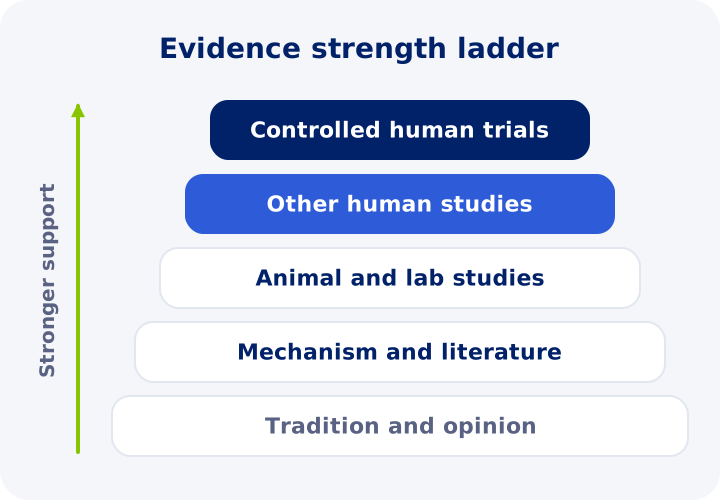
- Tradition and expert opinion can explain why an ingredient was chosen, but cannot carry a benefit claim on their own.
- Mechanism and literature reviews describe how an ingredient might act. They are useful background for technical audiences.
- Animal and laboratory studies, such as acid and bile tolerance tests, help screen strains and explain behaviour, but rarely substantiate a consumer benefit.
- Observational and open-label human studies suggest an effect in people but are open to bias.
- Randomised, controlled human trials in the target population are the strongest support for a health-related benefit.
Match the wording to the evidence
The most practical discipline is to choose claim wording that fits the evidence you hold today. The table below is a starting framework; local rules always decide the final wording.
| Claim type | Example wording | Evidence usually expected |
|---|---|---|
| Composition | “Contains Bacillus coagulans” | Identity test, CoA |
| Quality or process | “Count guaranteed to end of shelf life” | Stability data in final pack |
| General function | “May support digestive comfort” | Human studies on the same strain and dose |
| Comparative | “More stable than our previous formula” | Head-to-head data, same conditions |
| Disease-related | “Treats” or “prevents” a condition | Not permitted for foods or supplements |
Notice that the first two rows are within any manufacturer’s control. Strong, factual quality claims are often more persuasive to professional buyers than vague health language.
Why probiotic evidence is strain-specific
Probiotic effects are generally considered strain-specific. Two strains of the same species can behave differently in the gut, during processing and on the shelf. That has four consequences for claims:
- Strain: the study should use the same strain designation as your product, not just the same species.
- Amount: the daily amount in the study should match the amount the consumer receives at the end of shelf life, not at manufacture.
- Format: a strain tested in a refrigerated dairy drink may not behave the same way in a room-temperature tablet or gummy.
- Population: a study in one age group or health status does not automatically transfer to another.
Tip: Ask your supplier for stability data in a format close to yours. Spore-forming strains such as Bacillus coagulans are often chosen for shelf-stable formats, but the declared count should still be confirmed in your own matrix.
Building a substantiation file
A substantiation file turns good intentions into a repeatable system. It is the single place where marketing, R&D, QA and regulatory teams can see what is claimed and why.
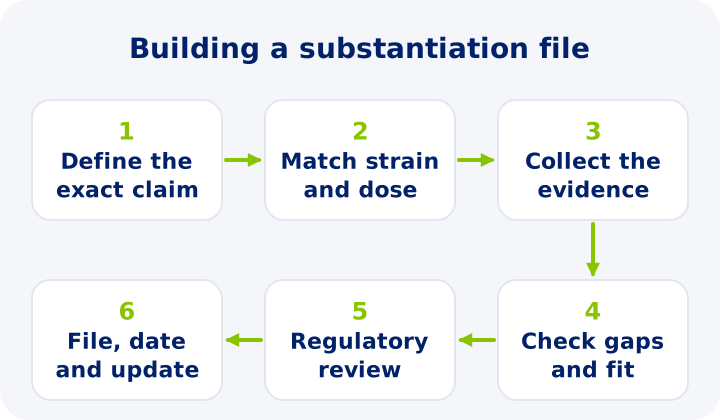
A practical file contains:
- The exact claim text, every place it appears (pack, website, sales deck, social posts) and the markets where it is used.
- Product details: strain designations, declared amounts, format and storage conditions.
- Evidence summaries: study design, population, dose, duration and outcome, with the full papers attached.
- Quality evidence: specifications, recent CoAs and stability reports for the finished product.
- Regulatory notes: the rule or guidance the wording relies on, and who signed it off.
- A review date, plus triggers for early review such as a supplier change, a new format or new published research.
The file should be owned jointly. R&D confirms the science, QA confirms the product matches the evidence, and marketing confirms the wording is used exactly as approved. Our companion guide on collaborating with R&D teams covers how to run that process day to day.
Presenting evidence to professional buyers
Formulators, QA managers and regulatory teams read evidence differently from consumers. They are not looking for headlines; they want to judge quickly whether the data applies to their product. A strong evidence pack for a professional buyer usually includes:
- A one-page summary of each key study: design, population, strain designation, daily amount, duration, outcome and limitations.
- A certificate of analysis confirming strain identity and the declared count or activity.
- Stability data in a format and pack close to the buyer’s intended product.
- Notes on regulatory status in the buyer’s target markets.
Be open about limitations. A short line such as “studied in healthy adults only” tends to increase credibility rather than reduce it, because it shows the supplier understands the evidence and is not stretching it.
Common mistakes to avoid
- Borrowing evidence from a different strain or a much higher dose.
- Quoting the count at manufacture instead of the count at expiry.
- Turning “may support” in the approved text into “boosts” or “fixes” in social media copy.
- Using laboratory results, such as survival in simulated gastric fluid, as if they proved a consumer benefit.
- Letting the file go stale after a reformulation or supplier change.
Clinical data is also the raw material for good brand communication. Once the facts are in order, our article on science-backed storytelling shows how to present them in a way buyers remember.
Working with Enzyme Bioscience
Enzyme Bioscience manufactures enzymes and probiotic strains in Surat, India, in a GMP, FDA-registered facility with in-house R&D and QC labs. We can provide samples, technical data sheets and certificates of analysis to support your composition and quality claims, and our certifications cover ISO 9001:2015, Halal, Kosher and FSSAI. To discuss documentation for a specific strain or blend, request a sample and TDS.
Frequently asked questions
Clinical data means results from studies in people, ideally well-designed controlled trials in a population similar to your customers. Laboratory and animal studies help explain a mechanism, but regulators generally expect human evidence before a health-related benefit is promoted.
Only with care. Effects of probiotics are generally considered strain-specific, so a study on one strain does not automatically support another strain of the same species. The strain designation, daily amount and format in the study should match your product as closely as possible.
It is a dossier that lists each claim you make and the evidence that supports it, such as study summaries, CoAs, stability reports and regulatory notes. It should be dated, version-controlled and reviewed whenever the formula, supplier or claim wording changes.
Factual composition and quality claims, such as the named strain, the declared count at the end of shelf life, or vegetarian and certification status, can usually be supported by specifications, CoAs and stability data. Any wording about a health or body-function benefit needs a stronger evidence base and local regulatory review.
We supply samples, technical data sheets and certificates of analysis on request, produced in our GMP, FDA-registered facility with in-house QC labs. These documents support composition and quality claims; brands remain responsible for health claim review in their own markets.