In this article
Enzymes are now standard tools on food production lines, from bakeries and meat plants to oil refineries and fruit processors. They let manufacturers change texture, yield and flavour with precision and under mild conditions. This article looks at enzymes from a process engineer’s point of view: how they work, where they fit and how to select, control and stop them.
What an enzyme does in a food process
An enzyme is a protein that speeds up a specific chemical reaction without being used up. Its active site fits a particular type of bond, such as the bonds between glucose units in starch or between amino acids in protein. This is why an amylase changes starch but leaves protein alone, and a protease does the reverse.
Food enzymes come from plants (papain, bromelain), animal tissue (some rennets and pancreatin) and, most often today, from fermentation using bacteria, fungi or yeasts. Fermentation gives consistent activity and scalable supply.
The four variables you control
Every enzyme reaction in a plant responds to the same four levers:
- Dose: more enzyme generally means a faster reaction, until substrate or conditions become limiting.
- pH: each enzyme has a working pH range; outside it, activity falls sharply.
- Temperature: activity rises with temperature up to a point, then the enzyme begins to denature.
- Time: the reaction keeps going while the enzyme is active, so holding time sets the end point.
Substrate quality matters too. Damaged starch in flour, the age of meat or the ripeness of fruit can all change how far and how fast an enzyme works.
Where enzymes fit across food manufacturing
Most food processes contain at least one step where an enzyme can do a job more gently than heat, acid or mechanical force. The table shows common examples.
| Process goal | Enzyme | Acts on | Typical use |
|---|---|---|---|
| Dough softness and volume | Fungal amylase, xylanase | Starch, arabinoxylan | Bread, buns |
| Meat tenderising | Papain, bromelain | Muscle proteins | Marinades, processed meat |
| Protein hydrolysis | Neutral or alkaline protease | Soy, whey, fish protein | Hydrolysates, seasonings |
| Oil degumming | Phospholipase | Phospholipids | Edible oil refining |
| Juice and purée yield | Pectinase, cellulase | Pectin, cell walls | Fruit and vegetables |
| Protein restructuring | Transglutaminase | Protein side chains | Surimi, meat, plant protein |
Bakery is one of the largest users; our bakery enzymes range covers amylases, xylanases, lipases and oxidases. Plant proteases such as papain are long-established for tenderising, while phospholipase is used in dough systems, egg yolk and oil processing. For drinks-specific uses, see our guide to enzymes in the food and beverage industry.
Chemical route vs enzymatic route
Many enzymatic steps replaced older chemical ones. Starch was once broken down mainly with acid, and protein hydrolysates were made with strong acid at high temperature. Enzymes do the same jobs at milder conditions and with fewer unwanted by-products.
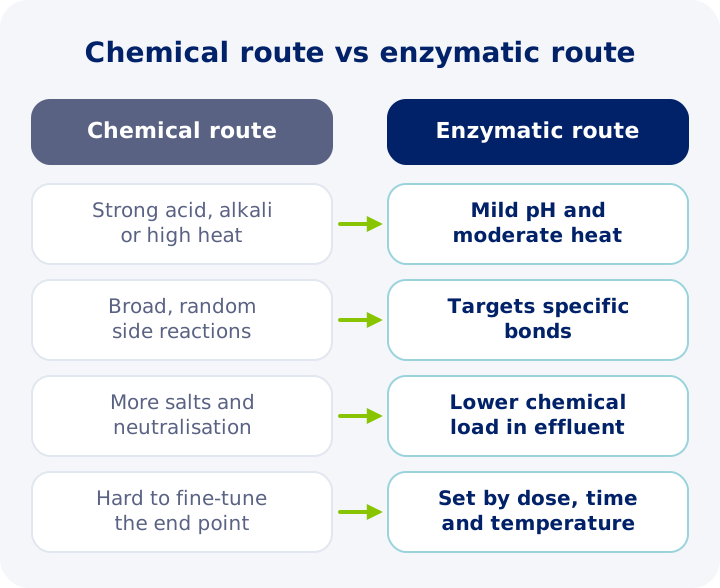
The trade-off is that enzymes need tighter process control. A chemical step is forgiving of small temperature swings; an enzyme step may not be. Good instrumentation and clear operating windows make enzyme processes reliable.
How to select and trial a food enzyme
Most enzyme projects that fail do so because the trial was too short, the end point was not defined, or plant conditions differed from the lab. A simple six-step route avoids that.
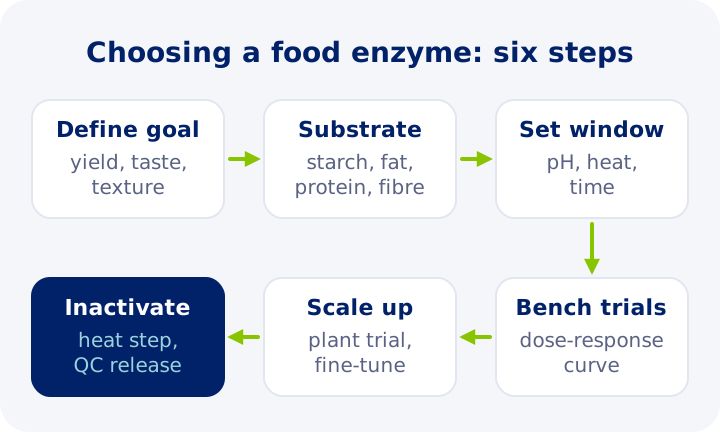
- Define the goal: put it in measurable terms, such as a target dough viscosity, juice yield or degree of hydrolysis.
- Identify the substrate: find the component that limits you, whether starch, protein, fat, pectin or fibre.
- Set the window: note the pH, temperature and time your process can actually provide.
- Run bench trials: test three to five doses to build a dose-response curve, using your own raw materials.
- Scale up: run a plant trial and fine-tune dose against real line conditions.
- Inactivate and release: confirm the stop step and the QC tests for the finished product.
Our enzyme dosage calculator helps set the first trial range. Dosage always depends on substrate and process, so treat any starting figure as a guide to be confirmed by trials.
Controlling and stopping the reaction
An enzyme step needs a measurable end point. Common ones include viscosity, dextrose equivalent (DE) for starch, degree of hydrolysis (DH) for protein, juice yield or Brix, and sensory or texture scores. Measure these at fixed times during trials so you know how quickly the reaction approaches target.
Stopping the reaction is just as important. Most enzymes are inactivated by heat in a later step such as baking, pasteurisation or blanching. If the product is not heated, plan a pH shift or a dedicated heat step, and test residual activity. Uncontrolled residual enzyme can soften texture, thin sauces or create off-flavours during storage.
Single enzymes or blends?
Many processes need more than one enzyme. Bread improvers, for example, often combine an amylase for softness with a xylanase for dough handling. A blend simplifies dosing on the line, but each component should first be tested on its own so you understand which one drives each effect. Once the roles are clear, a fixed blend reduces weighing errors and keeps results consistent from shift to shift.
Tip: Record enzyme lot numbers against production batches. If results drift, you can quickly see whether the cause is the enzyme, the raw material or the process.
Quality and regulatory checks
Before an enzyme enters a food plant, confirm the basics:
- Specification: activity, form and carrier, with a CoA for each lot.
- Food-grade status: compliance with recognised purity specifications and the rules of each target market.
- Allergens and source: carrier materials, production organism and any GMO declarations your customers need.
- Certifications: Halal, Kosher or FSSAI requirements for the products you sell.
- Storage and handling: shelf life, storage temperature and dust control for operators.
Working with Enzyme Bioscience
Enzyme Bioscience has made enzymes since 2012 at an FDA-registered, GMP and ISO 9001:2015 plant in Surat, with Halal, Kosher and FSSAI certifications. Our range of 100+ enzymes and probiotic strains includes the food enzymes above, and our ENZYVIVE® service builds custom blends. Request a sample, TDS or CoA to plan your next trial.
Frequently asked questions
A processing aid is used during manufacture for a technical purpose and has no function in the finished food, for example an enzyme inactivated by baking. A food additive keeps a function in the final product. How a given enzyme use is classified depends on local regulation, so check the rules for each market.
Most food enzymes are proteins that lose activity when heated above their stable range, so baking, pasteurisation, blanching or a dedicated heat step usually stops them. Some heat-stable enzymes need a stronger step or a pH change. Check residual activity if the product is not heated.
Raw materials, water, pH, temperature profile and holding time all differ between plants, and enzymes respond to each of them. Activity units also differ between suppliers. That is why a supplier's dose is only a starting point and local trials are needed.
Keep them sealed in a cool, dry place away from direct sunlight, and follow the storage conditions on the TDS. Activity slowly declines over time, and faster in heat and humidity. Use stock in rotation and recheck activity on older lots before critical batches.
Food-grade enzymes are made to purity specifications for use in food, but enzyme dust can cause respiratory sensitisation in workers who inhale it. Use dust control, avoid dry sweeping and provide suitable masks and gloves. Liquid or granulated forms reduce dust exposure.