
In this article
- Start with the intended use
- Check 1: strain identity
- Check 2: CFU at the end of shelf life
- Check 3: stability
- Check 4: delivery format
- Check 5: quality documents and certification
- Check 6: safety and sensible use
- Common mistakes when choosing a probiotic
- Putting the checks together
- Working with Enzyme Bioscience
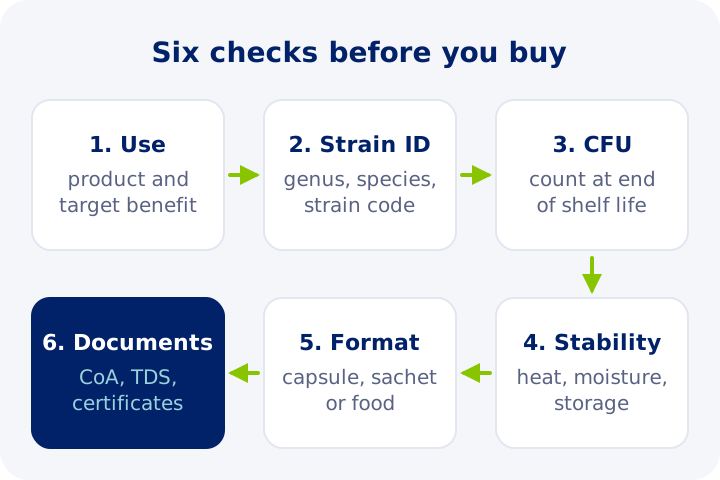
Choosing a probiotic is harder than it looks. Two products can carry the same species name and very different counts, stability and evidence. This guide walks formulators, buyers and informed consumers through six practical checks, from strain identity to the quality documents a supplier should provide. For an overview of the main genera and their typical uses, see our companion article on the best probiotics for optimal health.
Start with the intended use
Probiotics are live microorganisms which, when administered in adequate amounts, confer a health benefit on the host. The phrase “adequate amounts” and the word “benefit” both depend on the strain. A strain studied for digestive comfort in adults says nothing about a different strain of the same species, or about use in animal feed.
So begin with a short brief: the product type, the target user, the benefit you want to communicate, the format and the markets. That brief narrows the field quickly and makes every later check easier.
Check 1: strain identity
A properly identified probiotic is named by genus, species and strain code, for example “Genus species ABC-123”. The strain code links the material to the studies and safety data behind it. Identity should be confirmed by genetic methods such as 16S rRNA gene sequencing or whole-genome sequencing.
Be aware that names change. In 2020, the large Lactobacillus genus was split into 25 genera, so some strains now appear under new names such as Lactiplantibacillus plantarum. Make sure the names on your documents, label and regulatory filings match.
Check 2: CFU at the end of shelf life
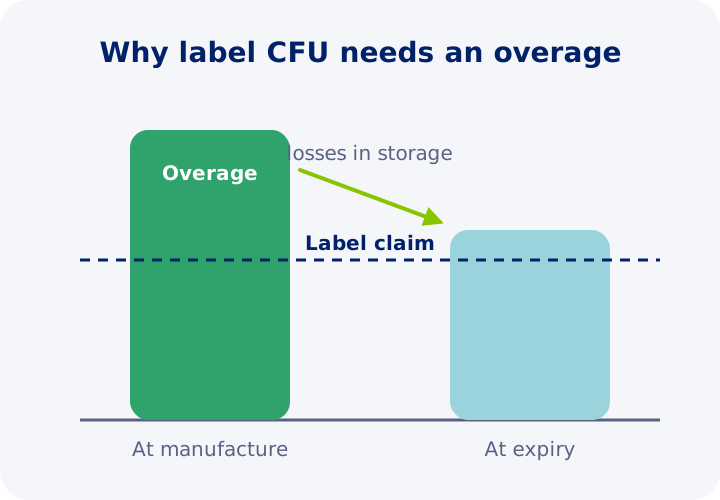
CFU stands for colony-forming units, the standard measure of viable cells. The count that matters is the one guaranteed at the end of shelf life. Viable counts fall during storage, so manufacturers add an overage at production to make sure the label claim is still met on the expiry date.
There is no universal “right” count. The dose should match what was used in studies on that strain. A very high count of a poorly documented strain is not better than a moderate count of a well-studied one. Ask how the count is measured: plate counting is the traditional method, and flow cytometry is increasingly used alongside it.
Check 3: stability
Most probiotics are sensitive to heat, moisture and oxygen, and some also to light. The main controls are:
- Strain choice: spore-forming strains such as Bacillus coagulans and Bacillus subtilis survive heat and dry storage far better than most lactobacilli and bifidobacteria.
- Drying and carriers: freeze-dried cultures on low-moisture carriers keep water activity down.
- Packaging: aluminium sachets, blisters or bottles with desiccant limit moisture and oxygen.
- Storage: some products need refrigeration; others are designed to be shelf-stable at room temperature.
Tip: Ask for real-time stability data at the conditions of your target market. For hot, very humid regions, that usually means ICH climatic zone IVb conditions of 30 °C and 75% relative humidity.
Check 4: delivery format
The format decides how much stress the strain faces in production and storage, and how easy the product is to use.
| Format | Strengths | Watch-outs | Typical use |
|---|---|---|---|
| Capsule | Accurate dose; acid-resistant options | Shell moisture; HPMC shells are drier than gelatin | Supplements |
| Sachet or powder | High doses; mixes into food or drink | Moisture once opened | Supplements, infant and adult nutrition |
| Tablet | Compact, low cost | Heat and pressure during compression | Supplements, chewables |
| Food or beverage | Fits daily habits | Processing heat and water activity | Dairy, bars, baked goods with spores |
| Feed premix | Bulk handling | Pelleting heat | Poultry, swine, aquaculture |
Acid-resistant capsules, enteric coatings or microencapsulation can help non-spore-forming strains reach the intestine in larger numbers.
Check 5: quality documents and certification
A serious supplier should provide, without hesitation:
- A certificate of analysis for each batch, showing CFU count, microbial limits and absence of specified pathogens.
- A technical data sheet with the strain designation, carrier, storage conditions and shelf life.
- Strain identity and safety information, including regulatory status in your markets, such as QPS status in the EU or GRAS status in the USA where applicable.
- Facility certifications, such as GMP and ISO 9001, with Halal, Kosher or FSSAI certificates where your market requires them.
Check 6: safety and sensible use
Probiotics are generally well tolerated by healthy people. Some users notice mild gas or bloating in the first days, which usually settles. People who are seriously ill, immunocompromised or in hospital should take medical advice before using probiotics. Labels and marketing should use wording such as “may support digestive health” and must never claim to treat, cure or prevent disease.
Common mistakes when choosing a probiotic
Several errors come up again and again in sourcing and product development:
- Choosing on species name alone, without a strain designation that links to evidence.
- Comparing products on CFU at manufacture rather than CFU guaranteed at expiry.
- Testing stability only in the raw material, then moving the strain into a wetter or hotter finished format.
- Assuming that more strains in one product always means more benefit. Each strain should earn its place on evidence and compatibility.
- Overlooking the carrier and excipients, which can bring in moisture, allergens or ingredients that conflict with a vegetarian, Halal or Kosher claim.
- Writing marketing copy before checking which claims the target market permits.
Avoiding these mistakes usually costs little at the start of a project and saves reformulation later.
Putting the checks together
The best probiotic for a given product is not the one with the biggest number on the label. It is a well-identified strain, with evidence that fits the intended use, delivered at a count that holds until expiry, in a format that protects it, from a supplier who can document every step. Use our product finder to shortlist strains by application.
Working with Enzyme Bioscience
Enzyme Bioscience manufactures probiotic strains and enzymes in Surat, India, under GMP and ISO 9001:2015, with in-house R&D and QC labs. TDS, CoA and samples are available for every strain. Request a sample to test viability in your own format.
Frequently asked questions
Start from the intended use and format, then look for strains with published data that matches that use. Check that the strain is identified to strain level, not just species, and that it is stable in your format. Ask the supplier for identity, safety and stability documents.
There is no single correct number. The count should match the dose used in studies on that strain and must be guaranteed to the end of shelf life, not just at manufacture. Manufacturers add an overage to cover losses during storage.
They can be, if the strain, drying process and packaging are designed for room-temperature storage and stability data supports the label count. Spore-forming strains are naturally shelf-stable. Non-spore-formers usually need dry, cool conditions or protective packaging.
Each has trade-offs. Capsules give accurate doses and can be acid-resistant, powders suit higher doses and mixing into drinks, and tablets are compact but involve compression stress. Choose the format that keeps your strain viable and suits your consumer.
Expect a certificate of analysis for each batch with CFU count and microbial limits, a technical data sheet, strain identity information and stability data. Facility certifications such as GMP and ISO 9001, plus Halal, Kosher or FSSAI where needed, show that quality systems are in place.