
In this article
- What is supplier qualification?
- Step 1: Which documents should you request?
- Step 2: Does the specification fit your use?
- Step 3: When is an audit needed?
- Step 4: How should change control work?
- Step 5: What stability evidence is enough?
- Step 6: How do you check traceability?
- How do you move from sample to full-scale supply?
- What are the red flags?
- A one-page checklist
- Working with Enzyme Bioscience
Qualifying an enzyme or probiotic supplier means collecting documented evidence that the supplier can deliver material that meets your specification every time, and that it will tell you before anything important changes. A practical checklist covers documents, specification and testing, audit, change control, stability and traceability. Approval then moves in stages from sample to full-scale supply, followed by ongoing monitoring.
This checklist is written for QA, regulatory and procurement teams in pharmaceutical, nutraceutical, food, feed and industrial companies. Adapt the depth of each step to the risk of the material and the requirements of your own quality system.
What is supplier qualification?
Supplier qualification is the documented process of deciding whether a supplier is fit to supply a specific material for a specific use. It is different from a commercial approval: a supplier can offer a good price and still fail qualification.
GMP frameworks for medicines, and most food and feed safety schemes, expect manufacturers to qualify the suppliers of their starting materials. The depth of the work should follow risk. An enzyme that is the active ingredient of a tablet needs more evidence than a processing aid in an industrial wash, but the structure of the review is the same.
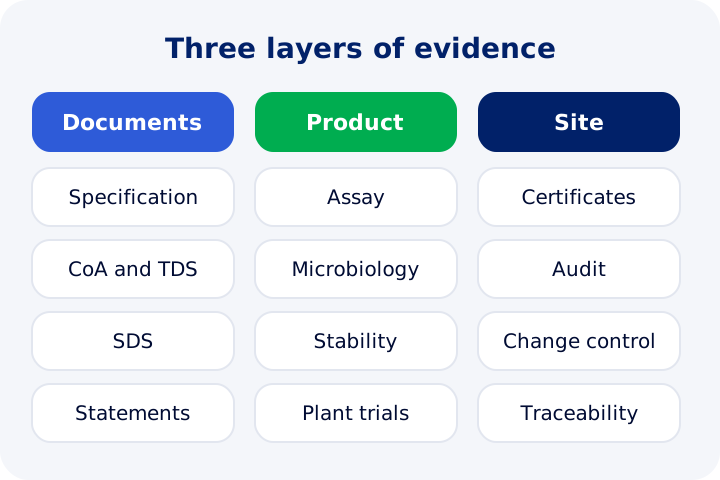
Step 1: Which documents should you request?
Start with a desk review. It is quick, cheap and filters out suppliers that cannot support your documentation needs.
| Document | What it confirms | Typical use |
|---|---|---|
| Specification | Agreed limits and test methods | Basis for every incoming check |
| Certificate of analysis | Batch results against the spec | Release of each delivery |
| TDS | Typical properties, storage, packing | Formulation and handling |
| SDS | Hazards and safe handling | Health and safety, transport |
| Quality certificates | GMP, ISO 9001, Halal, Kosher | Evidence of a working system |
| Statements | Allergens, GMO status, origin | Labelling and regulatory files |
Add a supplier questionnaire covering the manufacturing site, the process flow, quality-control testing and complaint handling. For animal-derived enzymes such as pepsin or pancreatin, ask for source-animal and BSE/TSE statements where your market requires them. For pharmaceutical use, ask which pharmacopoeial monograph the material meets and whether statements on residual solvents or elemental impurities are available.
The glossary explains the core documents: the certificate of analysis, technical data sheet and safety data sheet.
Step 2: Does the specification fit your use?
The specification is the contract for quality. Check each line against how you will use the material:
- Activity and unit: the assay method, substrate, pH and temperature behind the declared activity. Two products can only be compared when they use the same activity unit and method.
- Composition: the carrier or excipients used to standardise the powder, and whether they suit your label, for example vegetarian or allergen-free.
- Physical properties: form, particle size, moisture or loss on drying, and solubility where relevant.
- Microbiology: total counts and absence of specified organisms, especially for oral products.
- Probiotics: viable count in CFU per gram, strain identity, and the conditions under which the count is guaranteed.
Then verify. Test the first deliveries against the specification in your own laboratory, or through a contract laboratory, and compare your results with the supplier’s CoA.
Step 3: When is an audit needed?
An audit checks that the quality system described on paper works in practice. Use risk to decide the format: an on-site audit, a third-party audit, a remote audit or a questionnaire only.
Typical audit focus areas include raw-material control, fermentation or extraction records, segregation and cleaning, QC laboratory methods and equipment, batch record review, deviation and CAPA handling, complaint handling, and storage conditions for finished goods. For probiotics, add strain banking and contamination control.
Record the audit findings, agree corrective actions with deadlines, and close them before approval or at a defined follow-up. An audit report that lists observations but no follow-up adds little to the qualification file.
Step 4: How should change control work?
Enzymes and probiotics are biological products, so changes that look minor can affect performance. A change of production strain, fermentation medium, carrier or drying step can shift activity, stability or how the product behaves in your process.
Agree in a written quality agreement which changes the supplier will notify and how far in advance. A typical list includes:
- Production strain, source organism or raw-material origin.
- Manufacturing site or major equipment.
- Process steps, carrier or excipients.
- Packaging materials.
- Specification limits or test methods.
- Critical sub-suppliers.
The agreement should also say how you will assess the change, for example with new samples or comparative stability data, before it applies to your deliveries.
Step 5: What stability evidence is enough?
Ask for real-time stability data at the recommended storage conditions, any accelerated data, and the assay method used. Check that the packaging tested matches the packaging you will receive.
Supplier data on the raw material is a starting point, not the answer. Activity or viable count must also be confirmed in your own finished product, because moisture, pH and other ingredients in your formula can change the rate of loss. Our article on ingredient instability explains how stability affects the real cost of an ingredient.
Step 6: How do you check traceability?
Traceability means you can follow any batch back to its raw materials and forward to every customer who received it. Confirm that:
- Each pack carries a batch number that links to the CoA and batch record.
- Raw-material lots used in each batch are recorded.
- Retained samples are kept for a defined period.
- The supplier can run a mock recall and has a complaint-handling procedure.
How do you move from sample to full-scale supply?
Approval should be staged so that each step reduces risk before more volume is committed.
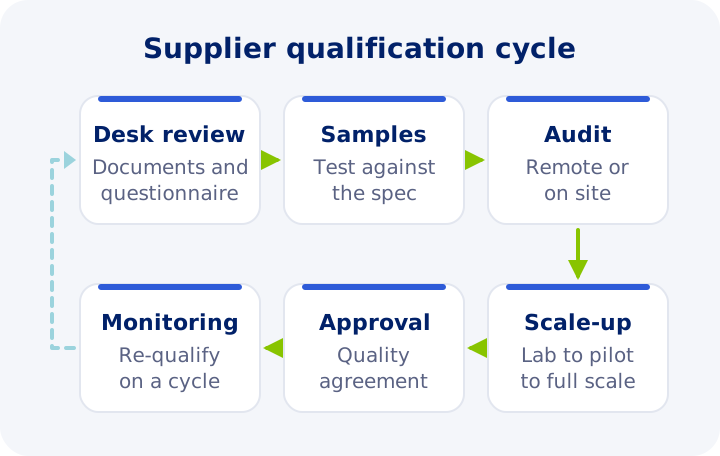
| Stage | Evidence collected | Decision |
|---|---|---|
| Laboratory sample | Spec tests, bench trial | Continue or reject |
| Pilot or plant trial | Process performance, product quality | Approve for first orders |
| First commercial batches | Full testing vs specification | Confirm consistency |
| Routine supply | CoA review, periodic full tests | Maintain approval |
| Re-qualification | Document update, trend review | Renew, restrict or remove |
The dose used in trials affects cost and performance, so record it carefully. The enzyme dosage calculator helps convert a target activity into a starting dose for trials.
Tip: Keep a short qualification file per material and supplier, not per supplier alone. The same supplier can be fully approved for one enzyme and still be under evaluation for another.
What are the red flags?
Some findings should pause a qualification until they are resolved:
- A CoA that reports activity without stating the assay method or unit.
- Certificates that have expired, or whose scope does not cover the product or site you are buying from.
- Reluctance to sign a quality agreement or to commit to change notification.
- Batch numbers that do not match across the CoA, the packing list and the pack label.
- No stability data, or data generated in different packaging from the one you will receive.
- Samples that were made specially, rather than drawn from a normal production batch.
None of these is always a reason to reject a supplier, but each needs a documented answer before approval.
A one-page checklist
- Specification agreed, with assay method and unit.
- CoA, TDS and SDS received and reviewed.
- Quality certificates current and in scope.
- Regulatory statements on file for your markets.
- Samples tested and trials passed.
- Audit or questionnaire completed according to risk.
- Quality agreement signed, including change notification.
- Stability data reviewed and confirmed in your product.
- Traceability and complaint handling confirmed.
- Monitoring and re-qualification cycle set.
If you are buying from overseas, our guide to importing enzymes from India covers export documents, HS codes and Incoterms.
Working with Enzyme Bioscience
Enzyme Bioscience has manufactured enzymes and probiotics in Surat, Gujarat, since 2012, in an FDA-registered, GMP facility certified to ISO 9001:2015, with Halal, Kosher and FSSAI certifications. Our certification page lists current approvals. To start a qualification, request samples, TDS and CoA and tell us which documents your QA team needs.
Frequently asked questions
Enzyme supplier qualification is the documented process of confirming that a supplier can consistently deliver enzymes that meet an agreed specification. It usually combines a document review, testing of samples, a risk-based audit, staged trials and ongoing monitoring after approval.
A supplier should normally provide a specification, a certificate of analysis for each batch, a technical data sheet and a safety data sheet. QA teams also ask for quality certificates such as GMP or ISO 9001, and statements on allergens, GMO status, origin and, for animal-derived enzymes, BSE/TSE risk where relevant.
Not always. Many companies use a risk-based approach, where critical materials such as pharmaceutical actives get an on-site or third-party audit, while lower-risk materials may be approved on a questionnaire, certificates and test results. The approach should be defined in the buyer's own quality procedures.
Customers usually expect advance notice of changes to the production strain or source, manufacturing site, process, carrier or excipients, packaging, specification, test methods and key sub-suppliers. The notice period and the list of notifiable changes should be written into a quality agreement.
There is no single rule. A common approach is to test a laboratory sample, then a pilot or plant trial, and then give the first few commercial batches full testing against the specification before moving to reduced testing. The number of batches should be set by the buyer's own risk assessment.
Re-qualification is usually done on a fixed cycle set by the buyer's quality system, and also after significant changes, quality failures or complaints. It typically repeats the document review, checks performance trends and, for higher-risk materials, includes a new audit.