In this article
Starch is one of the most widely processed raw materials in the world, and enzymes are now at the centre of how it is converted. They turn maize, wheat, cassava and potato starch into glucose, maltose and fructose syrups, maltodextrins and fermentable sugars. This article explains the enzyme cascade step by step and why it is more resource-efficient than older acid processes.
What starch is made of
Starch is a polymer of glucose units in two forms:
- Amylose: mostly long, straight chains in which glucose units are joined by alpha-1,4 bonds.
- Amylopectin: a highly branched molecule, with alpha-1,4 chains linked at branch points by alpha-1,6 bonds.
Raw starch granules do not dissolve in cold water. When heated in water they swell and gelatinise into a thick paste. The first job of starch processing is to thin this paste, and the second is to cut it down to the sugars the customer needs.
The starch enzyme toolkit
Each enzyme in a starch plant cuts a particular bond in a particular way. Choosing the right combination is how producers design a syrup.
| Enzyme | Acts on | Main product | Process step |
|---|---|---|---|
| Alpha-amylase (bacterial) | Internal alpha-1,4 bonds | Dextrins | Liquefaction |
| Glucoamylase | 1,4 and 1,6 bonds from chain ends | Glucose | Saccharification |
| Pullulanase | Alpha-1,6 branch points | Linear chains | Saccharification aid |
| Beta-amylase or maltogenic amylase | Alpha-1,4 bonds from chain ends | Maltose | Maltose syrups |
| Glucose isomerase | Glucose | Fructose | Isomerisation |
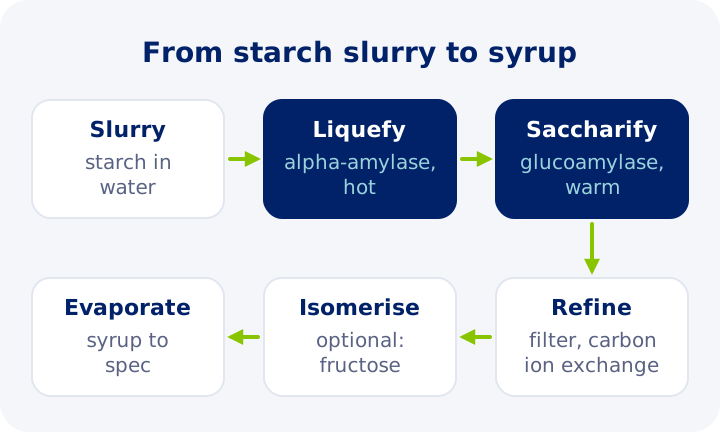
From slurry to syrup: the enzyme cascade
Liquefaction
Starch slurry is mixed with a heat-stable bacterial alpha-amylase and heated, often by steam jet cooking. As the starch gelatinises, the enzyme cuts long chains at random internal points. Viscosity falls quickly and the paste becomes a pumpable liquid of dextrins. Liquefied starch can be dried as maltodextrin or passed to saccharification.
Saccharification
The liquefied starch is cooled and the pH adjusted for the next enzyme. Glucoamylase removes glucose units one at a time from the chain ends and can also break branch points, though more slowly. Adding pullulanase speeds up the debranching and helps drive conversion towards glucose. For maltose syrups, beta-amylase or a maltogenic amylase is used instead, giving a syrup rich in maltose.
Refining and isomerisation
The syrup is filtered and refined, typically with activated carbon and ion exchange, to remove colour, protein, fat and salts. For fructose-containing syrups, glucose then passes over immobilised glucose isomerase, which converts part of it to fructose. Finally, the syrup is evaporated to its target solids.
Tip: Track dextrose equivalent (DE) or the sugar profile by HPLC at fixed intervals during saccharification. Stopping at the right point avoids reversion products that lower glucose yield.
Why enzymes beat acid hydrolysis
Before enzymes were widely adopted, starch was broken down mainly with acid at high temperature. Acid cuts bonds at random, so it offers little control over the sugar profile. It also creates colour, bitter by-products and reversion sugars.
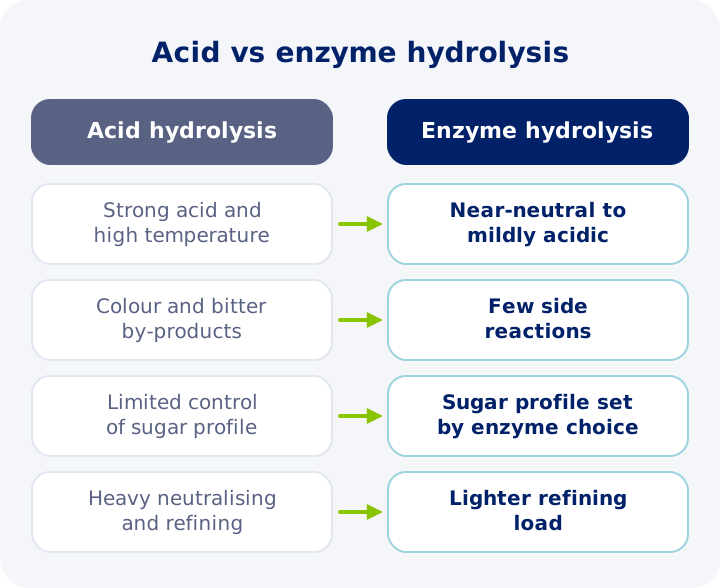
The sustainability case for enzymes rests on several established points:
- Fewer by-products: specific bond cleavage means less colour and fewer unwanted compounds to remove.
- Lighter refining: less carbon, ion-exchange regeneration and neutralising chemicals are needed per tonne of syrup.
- Better conversion: more of the starch ends up as the target sugar, so less raw material is wasted.
- Tailored products: one plant can make glucose, maltose or fructose syrups and maltodextrins by changing enzymes rather than equipment.
Beyond sweeteners: other starch applications
Fuel and beverage ethanol
Grain ethanol plants use the same cascade. Alpha-amylase liquefies the mash, and glucoamylase releases glucose for yeast, often during fermentation itself so that sugar is released as the yeast consumes it.
Textile desizing
Weavers coat warp yarns with starch size to protect them on the loom. Before dyeing, that size must be removed. Amylase desizing does this under mild conditions without damaging cotton fibres; see our Textzyme-DSZ desizing enzyme.
Paper and adhesives
Paper mills use alpha-amylase to reduce the viscosity of native starch for surface sizing and coating. Enzyme-modified starches are also used in adhesives and binders.
Common conversion problems and their causes
Even a well-designed cascade can drift. These are the issues starch plants meet most often:
- Poor filtration after saccharification: often a sign of incomplete liquefaction. Starch fragments that were not fully thinned can retrograde, forming insoluble particles that block filters. Check liquefaction temperature, holding time and alpha-amylase dose.
- Glucose yield below target: at high solids or long holding times, glucoamylase can slowly recombine glucose into reversion sugars such as isomaltose. Lower solids, a debranching enzyme or an earlier stop can help.
- Loss of enzyme activity: liquefaction enzymes lose activity quickly if temperature runs too high, pH drifts, or calcium is too low for the enzyme used.
- Colour in the final syrup: high temperature combined with long holds and residual protein encourages browning, which raises the refining load.
Logging temperature, pH and DE at each stage makes it much easier to find which variable has moved.
Practical points for starch processors
- Match enzyme to stage: liquefaction enzymes must tolerate high temperature; saccharification enzymes work at lower temperature and more acidic pH.
- Watch calcium and pH: many alpha-amylases need calcium for stability, and each stage has its own pH window.
- Define the end point: DE, viscosity or the sugar profile, depending on the product.
- Plan dosage by trial: dose depends on starch source, solids, temperature and time. Use our enzyme dosage calculator to set the first trial range.
The same enzymes also matter in cane and beet mills, where starch and dextran cause processing problems. Our article on enzymes in sugar production covers that side.
Working with Enzyme Bioscience
Enzyme Bioscience supplies amylases, glucoamylase and maltogenic amylase for starch, brewing and textile applications from its FDA-registered, GMP and ISO 9001:2015 plant in Surat. Our ENZYVIVE® service can tailor a blend to your process. Request samples, a TDS or a CoA to plan trials.
Frequently asked questions
Two enzymes do most of the work. A heat-stable alpha-amylase first liquefies the starch into shorter dextrins, then glucoamylase breaks those dextrins down to glucose. A debranching enzyme such as pullulanase is sometimes added to help glucoamylase deal with branch points.
Liquefaction is the hot first stage, where gelatinised starch is thinned by alpha-amylase into soluble dextrins. Saccharification is the cooler second stage, where glucoamylase or maltose-forming enzymes convert those dextrins into the target sugars.
DE stands for dextrose equivalent. It expresses the reducing sugar content of a syrup relative to pure glucose, which is set at 100, while starch is close to zero. A higher DE generally means a sweeter, more fully converted syrup.
Acid hydrolysis needs strong acid at high temperature and produces colour and off-flavour by-products that must be removed. Enzymes act more specifically under milder conditions, which reduces by-products, neutralisation chemicals and refining effort.
Yes. The same amylases and glucoamylases are used to make fermentable sugars for fuel ethanol, to remove starch size from woven fabric before dyeing, and to modify starch for paper sizing and coating.