
In this article
- What is a private-label blend?
- What goes into a good brief?
- How is the blend formulated?
- How do you choose probiotic strains for export markets?
- Which formats travel best?
- Why does stability decide the label claim?
- Who is responsible for labelling and regulatory compliance?
- How is the finished blend exported?
- Common pitfalls to avoid
- Working with Enzyme Bioscience
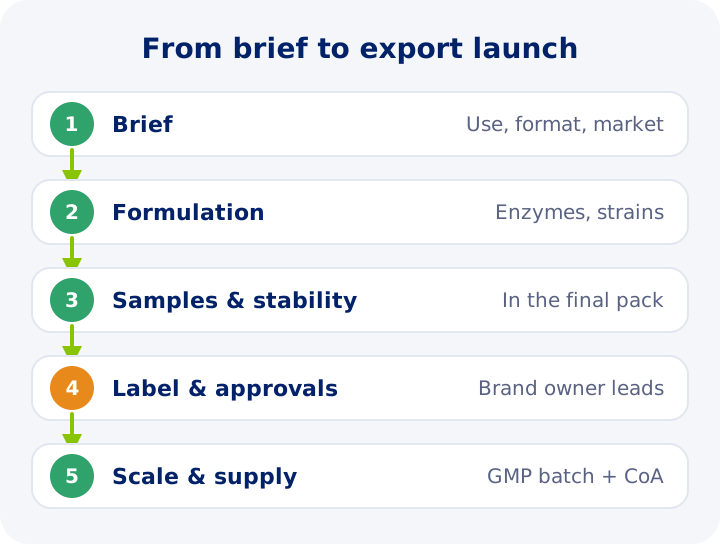
A private-label enzyme or probiotic blend is a formulation made by a manufacturer to a brand owner’s brief and sold under the brand owner’s name. For export markets, development runs in five stages: brief, formulation, samples and stability, labelling and approvals, then scale-up and supply. The brand owner stays responsible for the label, claims and registration in each country, while the manufacturer supplies the formulation and technical evidence.
This guide explains each stage, using ENZYVIVE®, the custom-blend service of Enzyme Bioscience, as the working example.
What is a private-label blend?
Private label means the product carries the buyer’s brand, not the manufacturer’s. In enzymes and probiotics, there are three common models:
| Model | What the brand owner gets | Typical fit |
|---|---|---|
| Ready formulation | An existing blend packed under your brand | Fast launch, proven format |
| Adapted formulation | A ready blend with dose, flavour or format changes | Differentiation with less development |
| Custom blend | A new formulation built to your brief | A unique product or a specific claim strategy |
An enzyme blend combines several activities, and sometimes probiotics, so that one product acts on different substrates at once. The ENZYVIVE® custom blends page shows the ready formulations and the custom route.
What goes into a good brief?
The brief is the single most useful document in the project. A vague brief leads to rounds of samples that answer the wrong question. Include:
- Use and market: what the product is for, who it is for, and which countries it will be sold in.
- Format and dose: powder, capsule fill, tablet, sachet or drink mix, with the serving size.
- Actives: the enzyme activities or probiotic strains you want, and the target activity or viable count at the end of shelf life, not just at manufacture.
- Label preferences: vegetarian, allergen-free, Halal or Kosher, and any ingredients to avoid.
- Packaging: bulk in 25 kg or 50 kg HDPE drums for your own packing, or retail pouches.
- Volumes and documents: expected order sizes, and the documents your regulatory team will need for each market.
If you plan to make health-related claims, say so early. Claims decide which ingredients and doses are worth considering, and the evidence must support the wording you intend to use in each market.
How is the blend formulated?
Formulation turns the brief into a specification. The R&D team selects the activities or strains, sets their levels, chooses a carrier to standardise the blend, and checks compatibility.
Key technical points include:
- Activity units: each enzyme in the blend is declared in its own unit, such as an amylase or protease unit. The dosage calculator helps translate target activities into an addition rate.
- Moisture control: water activity affects both enzyme stability and probiotic survival, so low-moisture ingredients and dry processing matter.
- Interactions: proteases can degrade other enzyme proteins, particularly in moist conditions, so combinations need testing.
- Probiotic overage: a justified overage keeps the viable count at or above the label claim through shelf life.
Our article on enzyme and probiotic synergy looks at how the two are combined.
How do you choose probiotic strains for export markets?
A probiotic is defined at strain level, not just by species, so the strain designation should appear on the specification and CoA. Before you lock the formula, check three things for every target market:
- Permitted species: some markets publish lists of species or strains accepted in foods or supplements. A strain that is accepted in one country may need extra approval in another.
- Naming: in 2020 the genus Lactobacillus was reclassified into several new genera, so Lactobacillus plantarum, for example, is now Lactiplantibacillus plantarum. Agree with your regulatory adviser which name each market expects on the label.
- Robustness: spore-forming probiotics are generally more tolerant of heat and moisture than many lactic acid bacteria, which makes them easier to use in shelf-stable formats for hot climates.
The probiotics range lists the species we supply.
Which formats travel best?
The format affects stability, regulatory category and shipping as much as the formula does:
- Powder in bulk: the most flexible option if you pack locally, but the blend must tolerate the time and conditions between production and your packing line.
- Capsules: choose the shell to match the label. Gelatin shells may not suit vegetarian or some Halal and Kosher products, while plant-based HPMC shells are common alternatives.
- Sachets and stick packs: single-dose packs limit repeated exposure to air and moisture, which helps sensitive probiotics.
- Drink mixes: these are usually opened and handled more often, so moisture protection and a realistic in-use period matter.
Why does stability decide the label claim?
Enzyme activity and probiotic viability decline over time, and heat and humidity speed up the loss. An exported product may sit in a warehouse in a hot or humid climate long before it is sold.
The ICH stability guidelines group the world into climatic zones and define standard long-term and accelerated test conditions. Even for food supplements, which are not always bound by pharmaceutical rules, these conditions are a useful reference. Test the blend in its final formula and pack, and set the label claim and shelf life from the results.
Tip: Test the pack you will actually sell. A blend that is stable in a sealed drum can behave very differently in a retail pouch that is opened daily.
Who is responsible for labelling and regulatory compliance?
The brand owner is responsible for what the product says and for whether it may be sold in each market. The manufacturer is responsible for making the product to the agreed specification and providing the evidence behind it.
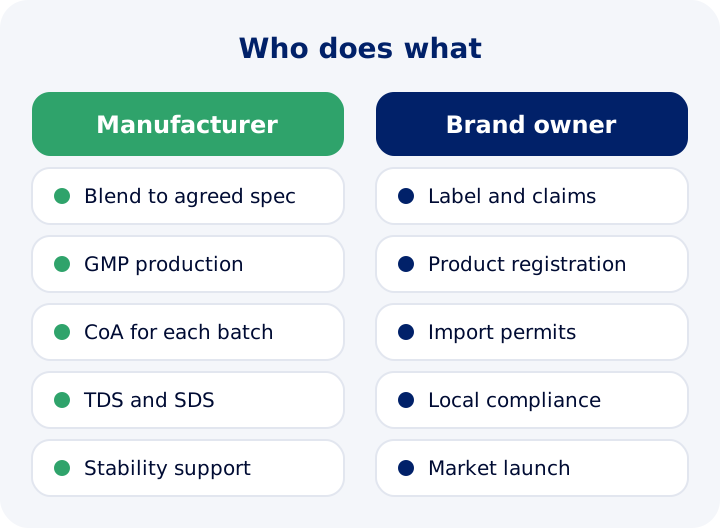
Rules differ widely between countries. Some markets require product registration or notification before sale, some restrict which probiotic strains or enzyme sources may be used, and many have specific rules for health claims. In parts of the EU, for example, the word “probiotic” itself can be treated as a health claim. Work with a regulatory adviser in each target market, and confirm the requirements before artwork is finalised.
| Document | Usually provided by | Used for |
|---|---|---|
| Specification and CoA | Manufacturer | Quality release, registration files |
| TDS and SDS | Manufacturer | Handling, storage, transport |
| Stability data | Manufacturer, confirmed by brand owner | Shelf life and label claim |
| Quality certificates | Manufacturer | Supplier approval, market access |
| Label artwork and claims | Brand owner | Sale in each market |
| Registration or notification | Brand owner or importer | Legal market entry |
How is the finished blend exported?
Once the blend is approved, shipments follow the normal export routine: commercial invoice, packing list, transport document, certificate of origin where requested, and a CoA for each batch. Finished blends may be classified under a different customs heading from single enzymes, so confirm the classification with your broker. Plan the first shipment with storage in mind as well: agree how the goods will be kept at the port, in the importer’s warehouse and during local distribution, because those conditions affect the label claim as much as the factory does.
Our guide to importing enzymes and probiotics from India covers documents, HS codes and Incoterms. Enzyme Bioscience serves customers in 21 countries across Asia, Europe, Africa and the Americas; the global supply page has more detail. Lead times, quantities and commercial terms are agreed per order.
Common pitfalls to avoid
- Copying claims from one market into another without checking local rules.
- Declaring probiotic counts at manufacture instead of at the end of shelf life.
- Running stability in a different pack from the one that will be sold.
- Changing an ingredient or supplier after approval without change control.
- Finalising artwork before the specification and stability data are agreed.
Working with Enzyme Bioscience
Through ENZYVIVE®, our R&D team formulates enzyme and probiotic blends to your brief and manufactures them in our FDA-registered, GMP facility in Surat, Gujarat, with Halal, Kosher and FSSAI certifications. Explore custom blends or request samples, TDS and CoA to start your brief.
Frequently asked questions
A private-label enzyme or probiotic blend is a formulation produced by a contract manufacturer and sold under the buyer's own brand. It may be a ready formulation adapted to the brand, or a fully custom blend developed to the brand owner's brief.
A good brief states the intended use, target markets, product format, dose per serving, the enzyme activities or probiotic strains wanted, and the target activity or viable count at the end of shelf life. It should also list certification needs such as Halal or Kosher, packaging, expected volumes and the documents the brand owner will need for registration.
The brand owner is responsible for the label, the claims and any product registration or notification in each market where the product is sold. The manufacturer supports this with specifications, certificates of analysis, stability data and other technical documents, but the brand owner decides what is said on the pack.
Enzyme activity and probiotic viability decline over time, and the rate of loss rises with heat and humidity. Exported products may be stored in hot or humid climates, so stability should be tested in the final formula and pack under conditions that reflect the target markets, and label claims should be set from those results.
Yes. Enzymes and probiotics are often combined in digestive and gut-health formulations. The combination needs careful control of moisture, because water activity affects both probiotic survival and enzyme stability, and the blend should be tested for both activity and viable count over shelf life.
ENZYVIVE® is the custom-blend service of Enzyme Bioscience, an Indian manufacturer of enzymes and probiotics. It covers blends that combine several enzyme or probiotic activities in one product, formulated to a customer's specification for brand owners and manufacturers.