
In this article
A probiotic’s CFU (colony-forming unit) count is the number of viable microorganisms that can grow into colonies on a culture plate, and BN is shorthand for billion CFU per gram of powder. Because viable counts fall during processing and storage, mainly through moisture, heat and oxygen, manufacturers add an overage so the label count is still met at the end of shelf life. The right overage comes from stability data for the specific strain, format and pack, not from a fixed rule.
What do CFU and BN mean?
A colony-forming unit is a viable cell, or a small chain or cluster of cells, that grows into one visible colony on an agar plate. To count CFU, a lab dilutes a sample in steps, spreads the dilutions on suitable media, incubates the plates and counts the colonies. The result is multiplied back up by the dilution factor to give CFU per gram or per serving.
BN is the shorthand used on culture specifications: 1 BN = 1 × 10⁹ CFU per gram. A 100 BN Lactobacillus plantarum powder therefore contains 100 billion CFU in each gram.
A few points about the method matter for formulators:
- Plate counts carry analytical variability, so one result is an estimate, not an exact number.
- Spore-forming Bacillus strains are often heat-treated before plating so that the spores are counted.
- Flow cytometry methods, such as ISO 19344 / IDF 232 for lactic acid bacteria, count cells by staining and can report active fluorescent units (AFU) instead of CFU.
Counts can also differ between laboratories testing the same lot. Sampling, rehydration of the dry powder, choice of medium, incubation conditions and the counting itself all add variation. When your incoming test does not match the supplier’s CoA exactly, compare the methods first, and agree a reference method in your specification.
Like enzyme activity units, a count is only comparable with another count from the same method. Our guide to enzyme activity units covers the same principle for enzymes.
Why do probiotic counts fall over time?
Probiotic bacteria in a dry powder are alive but dormant. They slowly lose viability, and several factors speed this up.
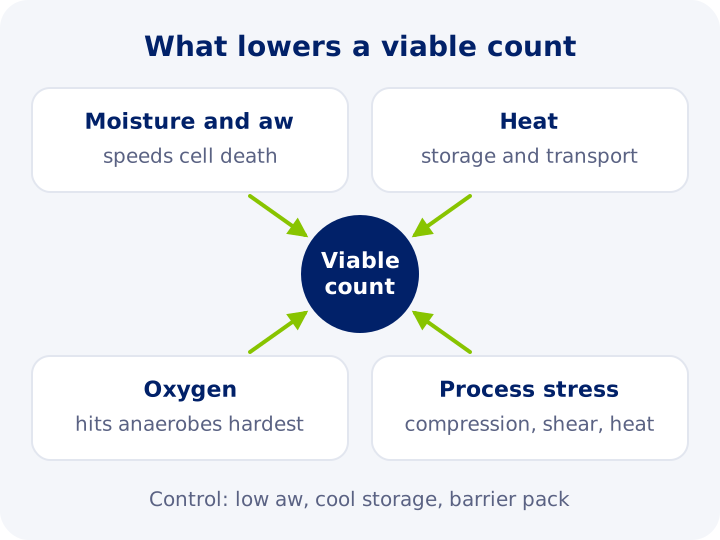
| Factor | Effect on viable count | Typical control |
|---|---|---|
| Moisture and water activity | Higher free water speeds up cell death in dry products | Low-moisture excipients, dry rooms, desiccants |
| Temperature | Higher storage and transport temperatures increase losses | Cool or refrigerated storage, cold-chain shipping |
| Oxygen | Damages sensitive strains, especially anaerobes such as bifidobacteria | Nitrogen flushing, oxygen-barrier packs |
| Process stress | Compression, shear, heat and mixing can kill cells | Gentle processing, adding cultures late |
| Ingredient interactions | Hygroscopic, acidic or antimicrobial ingredients can harm cells | Compatibility testing in the full formula |
Strain matters too. Spore-forming probiotics such as Bacillus coagulans tolerate heat and moisture much better than most lactic acid bacteria, which is why they are used in baked goods, beverages and gummies. Bifidobacteria are usually among the most sensitive. Our overview of probiotic genera compares them in more detail.
How is overage chosen?
Overage is the extra count added at manufacture so the label claim is still met at the end of shelf life. It should be based on data, not habit.
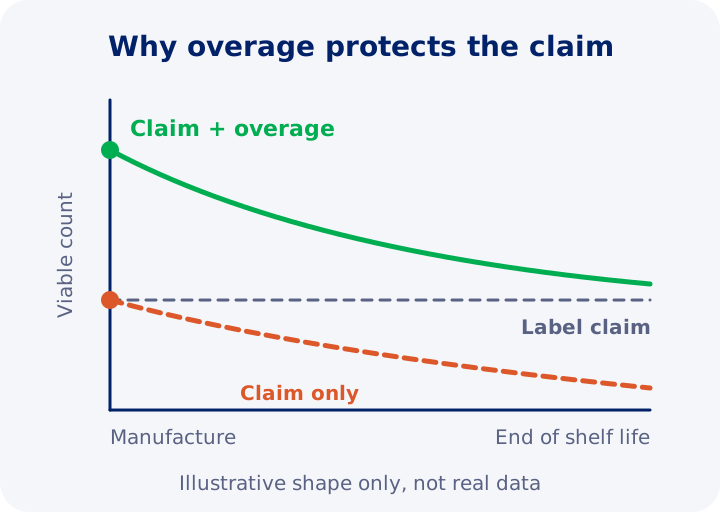
A sound approach has four steps:
- Run a stability study on the finished product in its final pack. Store samples at the labelled condition (real time) and at a harsher condition (accelerated), and test counts at set intervals across the intended shelf life.
- Calculate survival. Divide the count at the end of shelf life by the count at manufacture. This gives the survival fraction S.
- Convert survival to overage. Overage = 1 ÷ S − 1. The table shows the arithmetic.
- Add margins for losses during your own processing and for the variability of plate counts.
| Survival to end of shelf life (S) | Log loss | Overage needed (1 ÷ S − 1) |
|---|---|---|
| 90% | 0.05 log | 11% |
| 80% | 0.10 log | 25% |
| 70% | 0.15 log | 43% |
| 50% | 0.30 log | 100% |
| 25% | 0.60 log | 300% |
The numbers rise quickly. A loss of only 0.3 log, which sounds small, means half the cells have died and the product needs double the claim at manufacture. Repeat the study when you change the strain, supplier, excipients, format or pack, because each can change survival.
Accelerated studies are useful for screening formulas and packs quickly, but they do not replace real-time data. The claim on the label should be supported by counts measured at the storage condition stated on the pack, across the full shelf life, ideally on more than one batch.
How do format and packaging affect shelf life?
| Format | Main stability challenge | Common approach |
|---|---|---|
| Capsules | Moisture in shell and fill | Low-moisture shells (e.g. HPMC), dry fill, desiccant bottles or blisters |
| Tablets | Heat and pressure in compression | Controlled compression force, robust strains |
| Sachets and stick packs | Moisture and oxygen ingress | Foil laminate packs, low water activity fill |
| Gummies, bars, baked goods | Heat and high water activity | Spore-forming strains |
| Oil drops | Contact with water | Culture suspended in oil |
Packaging is part of the formula. Aluminium blisters, foil laminate sachets, and bottles with desiccants and induction seals all reduce moisture and oxygen ingress. Nitrogen flushing lowers oxygen in the headspace. For bulk culture powders, keep containers sealed, store them as the TDS directs and allow cold material to reach room temperature before opening, so moisture does not condense on the powder. We pack bulk material in 25 or 50 kg HDPE drums or in retail pouches. Our article on nutraceutical ingredient instability covers packaging and storage in more depth.
Worked example: culture per serving with overage
The formula is the same as the probiotic tool in our enzyme dosage calculator. All numbers below are illustrative.
You want to claim 10 billion CFU per capsule to the end of shelf life, using a 100 BN culture, with a 30% overage.
- Culture per serving (g) = claim (billion CFU) × (1 + overage) ÷ potency (BN)
- 10 × 1.30 ÷ 100 = 0.13 g, or 130 mg per capsule
For a batch of 100,000 capsules you need 13 kg of culture powder. If each capsule holds 500 mg of fill, the culture takes 26% of the fill and excipients make up the rest.
Now suppose your stability study shows 70% survival. The table gives an overage of about 43%, so the culture per capsule becomes 10 × 1.43 ÷ 100 = 143 mg, and the batch needs 14.3 kg. Use the potency from the culture’s CoA rather than the nominal grade, and calculate each strain separately in a multi-strain product.
Tip: If the calculated culture per serving is larger than the serving itself, you need a higher-potency culture, a larger serving or a lower claim.
How should the label claim be stated?
The most useful claim, and the one widely expected by regulators and buyers, is the count guaranteed until the end of shelf life, not the count at manufacture. A clear label names each strain with its designation, states the CFU per serving at expiry and gives the storage conditions that the stability data support.
Keep health wording within what is permitted in each market. Probiotic benefits are strain-specific, so any claim should relate to the strain in the product and the evidence behind it.
Working with Enzyme Bioscience
Enzyme Bioscience supplies probiotic strains in a range of potencies, each with a TDS and a batch CoA from our in-house QC lab. We can combine probiotics with enzymes in an ENZYVIVE® custom blend. Request samples and a TDS for the strains you want to put on stability.
Frequently asked questions
CFU stands for colony-forming unit. It is the number of viable microbial cells, or small clusters of cells, that can grow into a visible colony on a culture plate. A label stating 10 billion CFU per capsule means the product should contain at least that many viable organisms per capsule, ideally guaranteed to the end of shelf life.
BN means billion CFU per gram. A culture powder of 100 BN contains 100 × 10⁹ CFU in each gram. It is the potency figure you use to calculate how much culture powder each serving needs.
Overage is the extra viable count added at manufacture, above the label claim, to cover losses during processing and storage. Without it, a product that meets its claim on the day it is made may fall below the claim before its expiry date. The amount is set from stability data for the specific strain, format and packaging.
If stability data show that a fraction S of the count survives to the end of shelf life, the overage needed is 1 ÷ S − 1. For example, 80% survival needs a 25% overage and 50% survival needs 100%. Add a margin for processing losses and assay variability, then calculate culture per serving as claim × (1 + overage) ÷ potency.
Probiotic bacteria are living cells that slowly lose viability in storage. Moisture and high water activity, heat, oxygen and stresses such as compression or shear all speed up the loss. Low water activity, cool storage and barrier packaging slow it down.
The more reliable and widely expected practice is to state the count guaranteed until the end of shelf life. A count at manufacture tells the buyer little about what remains when the product is used. Check the specific labelling rules of each market where the product will be sold.