In this article
- Why are enzymes sold by activity rather than weight?
- What is an enzyme unit (U or IU)?
- What is a katal?
- U/g vs U/mg: what is the difference?
- Which method-specific units will you see?
- Why aren’t activity units comparable across assays?
- How should you compare two enzyme offers?
- Worked example: standardising a concentrate
- Working with Enzyme Bioscience
An enzyme activity unit measures how much catalytic work an enzyme preparation does, meaning how fast it converts a substrate under defined assay conditions, rather than how much it weighs. The general unit (U or IU) is the amount of enzyme that converts 1 micromole of substrate per minute, and the SI unit is the katal (1 mole per second). Industry also uses method-specific units such as SKB, BAU, GDU, HUT, TU, ALU and IMCU, and two numbers can only be compared when they come from the same assay.
Why are enzymes sold by activity rather than weight?
Enzyme powders and liquids are mixtures. The active protein is usually a small part of the product, standardised with a carrier such as maltodextrin, starch or salt. Two products of the same weight can therefore do very different amounts of work. Activity tells you how much catalytic effect you are buying, and it is the figure your dose, label claim and price should be based on.
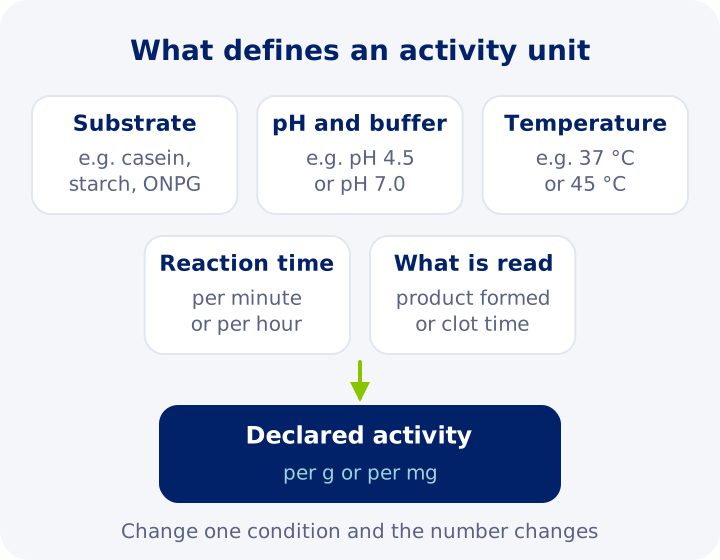
Activity is always measured with a defined method. The method fixes the substrate, pH, buffer, temperature, reaction time and what is measured at the end. Change any of these and the result changes, even for the same batch.
What is an enzyme unit (U or IU)?
The enzyme unit (U) is the amount of enzyme that converts 1 µmol of substrate per minute under the stated assay conditions. The international unit (IU) is the same definition as standardised by the International Union of Biochemistry, and the two are used interchangeably in practice.
The weakness of “U” is that it does not name the conditions. One supplier may measure a protease on casein at pH 7.5, another on a synthetic peptide at a different temperature. Both may write “U/g”, yet the numbers are not equal. Always ask which substrate and conditions sit behind a generic unit.
What is a katal?
The katal (kat) is the SI unit of catalytic activity: the amount of enzyme that converts 1 mole of substrate per second. It is a very large unit, so values are usually given in microkatal (µkat) or nanokatal (nkat).
- 1 U = 1 µmol/min = 1/60 µmol/s ≈ 16.67 nkat
- 1 kat = 60 mol/min = 6 × 10⁷ U
The katal is common in scientific literature and some regulatory dossiers. Commercial data sheets still mostly use U or a method-specific unit.
U/g vs U/mg: what is the difference?
Activity is stated per amount of product: U/g or U/mg. Since 1 g = 1,000 mg, 1 U/mg = 1,000 U/g. Papain, for example, is often declared in TU/mg, while most food and feed enzymes are declared per gram. A figure of 50 TU/mg equals 50,000 TU/g. Misreading the basis is one of the most common causes of a dose that is out by a factor of 1,000.
Which method-specific units will you see?
Many enzymes have their own established assays, often from the Food Chemicals Codex, ISO/IDF standards or pharmacopoeias. The table summarises the units you are most likely to meet. Full definitions are in our enzyme glossary.
| Unit | Enzyme | Basis of the assay | Typical use |
|---|---|---|---|
| SKB | Fungal alpha-amylase | Dextrinises 1 g soluble starch per hour at 30 °C, with excess beta-amylase | Baking, flour correction |
| BAU | Bacterial alpha-amylase | Starch dextrinisation under Food Chemicals Codex conditions | Starch, brewing, baking |
| PC | Neutral bacterial protease | Casein substrate at near-neutral pH (FCC method) | Food protein processing |
| HUT | Acid (fungal) protease | Haemoglobin substrate at pH 4.7 | Food, brewing, digestive blends |
| GDU | Bromelain, papain | 1 mg amino nitrogen from gelatin, 20 min, 45 °C, pH 4.5 | Supplements, protein processing |
| TU | Papain and other proteases | Tyrosine-equivalent peptides released from casein per minute | Papain grades (often TU/mg) |
| ALU | Fungal lactase | ONPG substrate at pH 4.5 and 37 °C | Supplements, acidic dairy |
| IMCU | Rennet and coagulants | Milk clotting time against a reference standard (ISO 11815 / IDF 157) | Cheese making |
| FIP | Pancreatin and others | Pharmacopoeial assays | Pharmaceutical grades |
| CFU / BN | Probiotics (not enzymes) | Viable colonies on a plate; BN = 10⁹ CFU/g | Probiotic specifications |
Carbohydrase units such as XU, BGU and PGU and cellulase units are usually based on reducing sugar released per minute, but their definitions vary between suppliers. Feed phytase is usually declared in FTU, discussed in our phytase guide.
Why aren’t activity units comparable across assays?
Each assay measures a different reaction. A protease that is very active on gelatin at pH 4.5 may behave quite differently on casein at neutral pH or on haemoglobin at pH 4.7. Its result also depends on reaction time, temperature, how the end point is detected and, for some methods, a reference standard. There is no fixed factor that turns GDU into HUT, or SKB into BAU.
Even identical unit names can hide different methods. Two suppliers may both quote xylanase in “XU/g” while using different xylan sources or conditions. And no lab assay fully predicts performance in your matrix, which has its own pH, temperature, inhibitors and processing time. Our papain and bromelain comparison shows why this matters for two closely related enzymes.
How should you compare two enzyme offers?
A fair comparison follows a simple order. First confirm that both offers use the same unit and the same assay method. If they do, convert both to the same basis and compare cost per unit of activity. If they do not, ask each supplier for the method and run a side-by-side trial at equal cost or equal dose.
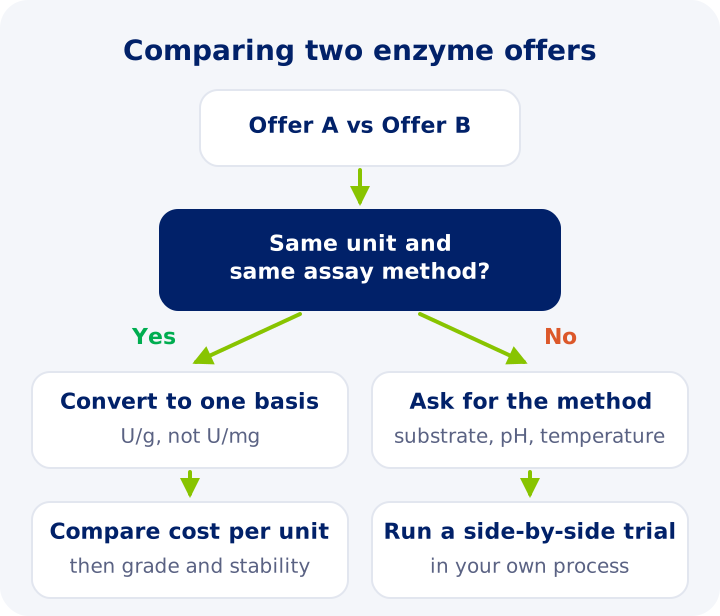
The example below uses invented, illustrative numbers and a price index rather than real prices. It shows why price per kg alone can mislead.
| Illustrative example | Offer A | Offer B |
|---|---|---|
| Declared activity (same method) | 100,000 U/g | 60,000 U/g |
| Units per kg | 10⁸ U | 6 × 10⁷ U |
| Price index per kg | 100 | 70 |
| Price index per million U | 1.00 | 1.17 |
Offer B is cheaper per kg but more expensive per unit of activity. Beyond cost, check the grade, stability over shelf life and any overage built into the declared figure, and confirm that the CoA reports the same method as the TDS.
Tip: Ask for the assay method by name or reference when you request a sample. A supplier that cannot tell you how activity is measured cannot guarantee that the next batch will behave the same way.
Worked example: standardising a concentrate
The formulas below are the same as those in our enzyme dosage calculator. All numbers are illustrative.
Step 1: standardise to a target activity. You have a concentrate at 100,000 U/g and need a 100 kg batch at 10,000 U/g.
- Concentrate (kg) = target activity × batch (kg) ÷ concentrate activity
- 10,000 × 100 ÷ 100,000 = 10 kg concentrate + 90 kg carrier
To build in a 10% overage for process and storage losses, raise the target to 11,000 U/g. The batch then needs 11 kg concentrate and 89 kg carrier.
Step 2: work out the process dose. Your trials show that the process needs 5,000 U per kg of substrate, and you treat 1,000 kg of substrate with the 10,000 U/g product.
- Enzyme (g) = units per kg substrate × kg substrate ÷ product activity (U/g)
- 5,000 × 1,000 ÷ 10,000 = 500 g, which is 500 g per tonne or 0.05%
Step 3: express it in other units if needed. 10,000 U/g equals 10 U/mg, or about 166,700 nkat/g (167 µkat/g).
These steps only hold when all values come from the same assay. The required units per kg of substrate should come from your own trials or from application guidance for that specific product.
Working with Enzyme Bioscience
Every Enzyme Bioscience product is supplied with a TDS that states its activity unit, and each batch comes with a CoA from our in-house QC lab. Our ranges include fungal amylase in SKB, acid protease in HUT, lactase in ALU and rennet in IMCU. Request samples, a TDS and CoA to run your own side-by-side comparison.
Frequently asked questions
An enzyme activity unit expresses how fast an enzyme preparation converts its substrate under defined assay conditions. The general enzyme unit (U) is the amount of enzyme that converts 1 micromole of substrate per minute. The substrate, pH, temperature and reaction time must be stated, because the value changes if any of them change.
IU is the international unit defined by the International Union of Biochemistry: 1 µmol of substrate converted per minute under defined conditions. In practice IU and U are used interchangeably on most data sheets. Neither tells you the assay conditions, so always check the method behind the number.
Multiply by 1,000, because there are 1,000 milligrams in a gram. For example, an enzyme declared at 50 U/mg contains 50,000 U/g. Convert both offers to the same basis before comparing dose or price, but only when they use the same assay method.
No reliable fixed conversion exists. GDU, TU and HUT are measured on different substrates (gelatin, casein and haemoglobin) at different pH and temperature, so the same protease gives a different number in each assay. Compare such products with a side-by-side application trial instead.
The katal is the SI unit of catalytic activity: the amount of enzyme that converts 1 mole of substrate per second. One enzyme unit equals 1/60 µmol per second, or about 16.67 nanokatal. Katal values are common in scientific papers and some regulatory documents, while industry data sheets usually use U.
No. CFU (colony-forming unit) counts viable microorganisms that can grow into colonies on a plate, so it is used for probiotics, not enzymes. BN is shorthand for billion CFU per gram. It appears on the same specifications because many blends contain both enzymes and probiotics.