
In this article
- What are papain and bromelain?
- How do papain and bromelain compare?
- How are papain and bromelain activities measured?
- How do pH and temperature affect them?
- Where are papain and bromelain used?
- How do you choose between papain and bromelain?
- Can papain and bromelain be used together?
- Working with Enzyme Bioscience
Papain and bromelain are both plant cysteine proteases that break proteins into smaller peptides, but they come from different sources: papain from the latex of unripe papaya (Carica papaya) and bromelain mainly from the stem of the pineapple plant (Ananas comosus). Papain is usually declared in tyrosine units (TU), often per milligram, while bromelain is usually declared in gelatin digesting units (GDU) per gram. Choose between them by application, grade and process conditions, and confirm the choice with a trial rather than a unit conversion.
What are papain and bromelain?
Both enzymes belong to the cysteine protease family. Their active site depends on a cysteine residue with a free thiol group, which is why assays often include an activator such as cysteine, and why oxidising agents and some heavy-metal ions inhibit them. Both have broad specificity, meaning they cut many different peptide bonds in a protein.
Papain is obtained by scoring unripe green papaya fruit and collecting the latex. The dried latex is crude papain, which also contains related proteases such as chymopapain. It is refined and standardised into food, feed and pharmacopoeial grades.
Bromelain is the name for the protease preparation extracted from pineapple. Commercial bromelain comes mainly from the stem (stem bromelain); fruit bromelain is a closely related enzyme. Crude bromelain is a mixture of several cysteine proteases and other plant components.
A familiar kitchen example shows both enzymes at work. Fresh pineapple or papaya stops gelatin desserts from setting, because their proteases break down the gelatin. Canned or cooked fruit does not, because heating has inactivated the enzymes.
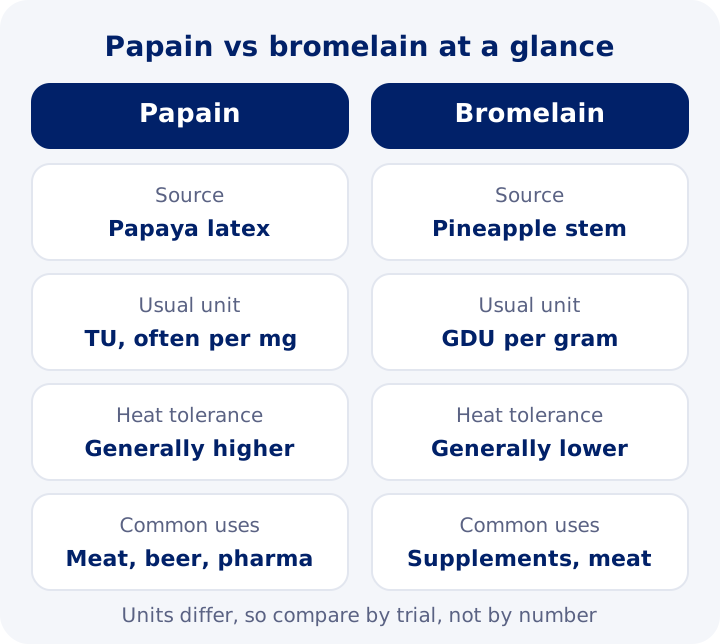
How do papain and bromelain compare?
| Feature | Papain | Bromelain |
|---|---|---|
| Source | Latex of unripe papaya | Pineapple stem (and fruit) |
| Enzyme family | Cysteine protease | Mixture of cysteine proteases |
| Usual activity unit | TU, often per mg | GDU per gram |
| pH behaviour | Active over a broad range, around slightly acidic to neutral | Active over a broad range, around slightly acidic to neutral |
| Heat tolerance | Generally higher | Generally lower |
| Typical grades | Food, feed, IP/USP | Food, pharmaceutical |
How are papain and bromelain activities measured?
Papain is commonly expressed in tyrosine units (TU), based on the amount of tyrosine-equivalent peptides released from casein per minute. Because papain is a concentrated enzyme, values are often given per milligram rather than per gram.
Bromelain is usually expressed in gelatin digesting units (GDU). One GDU liberates 1 mg of amino nitrogen from a standard gelatin solution after 20 minutes at 45 °C and pH 4.5. Some suppliers also quote bromelain in milk-clotting units, and pharmacopoeial papain is tested by the method in its monograph.
These assays use different substrates and conditions, so there is no fixed factor that converts TU into GDU. The same rule applies to all enzyme activity units: compare numbers only within one method, and compare different methods by trial.
How do pH and temperature affect them?
Both enzymes work across a broad pH range, which is one reason they are useful in so many foods. Activity falls towards strongly acidic or alkaline conditions, and the exact optimum depends on the substrate and the preparation.
Temperature is where they differ most in practice. Papain is generally regarded as the more heat-tolerant of the two and can keep working as food heats up, until it is eventually inactivated. Bromelain tends to lose activity at lower temperatures. This matters in cooking, brewing and any process with a heat step: a heat-tolerant protease keeps working longer, which can be helpful or can over-soften a product. Time at temperature, the food matrix and the formulation all affect the outcome, so test under your own conditions.
Where are papain and bromelain used?
| Application | Papain | Bromelain | Notes |
|---|---|---|---|
| Meat tenderising | Yes | Yes | Dose carefully; too much gives a mushy texture |
| Protein hydrolysis | Yes | Yes | Hydrolysates and flavour bases |
| Beer chill-proofing | Yes, traditional | Less common | Breaks down haze-forming proteins |
| Dietary supplements | Yes | Yes, very common | Digestive enzyme blends |
| Pharmaceutical grades | Papain IP/USP | Pharma grade | Monograph or specification controls quality |
| Cosmetics | Yes | Yes | Enzyme exfoliant products |
| Animal feed | Yes | Less common | Protein digestibility in feed |
Food processing
In meat and seafood, both enzymes break down muscle and connective-tissue proteins to make tough cuts more tender. In protein processing they are used to produce hydrolysates for flavour and functional ingredients. Papain has a long history of use in brewing to break down proteins that cause chill haze. Our food grades are listed on the papain and bromelain product pages within the food enzymes range.
Supplements and pharmaceuticals
Both enzymes are used in digestive enzyme formulations intended to support protein digestion, often alongside amylase and lipase. Bromelain is also widely sold as a single-ingredient dietary supplement. Health claims for either enzyme must follow the regulations of the target market.
Pharmaceutical manufacturers need material tested to a pharmacopoeial monograph or an agreed specification. Our Papain IP/USP and pharmaceutical-grade bromelain sit in the pharmaceutical enzymes range.
Other industries
Papain and bromelain are used in cosmetic exfoliant products, where they act on proteins in the outer skin layer. Papain is also used in animal feed to help break down dietary protein. For more on papain alone, see our article on papain’s uses in health and industry.
How do you choose between papain and bromelain?
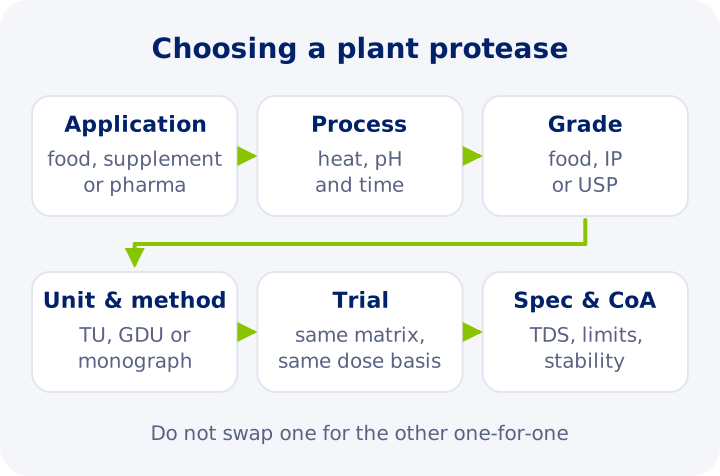
Start with the application and any label requirement. A supplement brand may need “bromelain from pineapple” on the label, while a brewer or meat processor may care only about performance. Then look at the process: a heat step favours a more heat-tolerant enzyme, while a short, mild process may suit either.
Next, fix the grade. Food products need food-grade material, pharmaceutical products need the pharmacopoeial grade named in the dossier, and feed products need feed-grade material. Agree the unit and method before comparing prices, and run a side-by-side trial in your own matrix at equal cost or equal effect.
Finally, write the specification. For either enzyme it should cover:
- Activity with the unit, the method and the basis (per mg or per g).
- Assay conditions, including any activator used, so your QC lab can reproduce the result.
- Carrier and form, such as powder or liquid, and what the enzyme is standardised with.
- Microbiology and contaminants, in line with food, feed or pharmacopoeial requirements for the grade.
- Moisture and storage, with the shelf life and storage conditions the supplier supports.
Both raw materials are agricultural, so it is sensible to ask about supply continuity too.
Can papain and bromelain be used together?
Yes. Because they come from different plants and have slightly different activity profiles, the two are often combined. Digestive enzyme formulations may include both alongside other proteases, amylase and lipase, so that the blend acts on a wider range of proteins. Some meat-tenderising and protein-processing preparations also combine plant proteases. When you blend them, declare each enzyme in its own unit, check that neither degrades the other over shelf life, and confirm the combined effect by trial rather than by adding the numbers together.
Tip: Papain and bromelain powders, like other enzyme powders, can cause respiratory sensitisation. Use dust control when handling them, and check allergen and labelling rules for the markets you sell into.
Working with Enzyme Bioscience
Enzyme Bioscience supplies papain and bromelain in food and pharmaceutical grades, and papain for feed, all produced in our FDA-registered, GMP and ISO 9001:2015 certified facility. Each product has a TDS stating its activity unit and method, and every batch is released with a CoA. Request samples of both to compare them in your own process.
Frequently asked questions
The main difference is the source. Papain is extracted from the latex of unripe papaya fruit, while bromelain is extracted mainly from pineapple stem. Both are cysteine proteases that break proteins into peptides, but they differ in activity profile, heat tolerance, the units used to declare them and their typical applications.
Not one-for-one. They are declared in different units (usually TU for papain and GDU for bromelain), they behave differently with heat and pH, and a label may name a specific source. If you want to switch, run a side-by-side trial in your own product and check regulatory and labelling requirements.
Papain is commonly expressed in tyrosine units (TU), often per milligram, based on peptides released from casein. Bromelain is usually expressed in gelatin digesting units (GDU) per gram, based on amino nitrogen released from gelatin at pH 4.5 and 45 °C. Some suppliers also use milk-clotting units, and pharmacopoeial grades use the method in their monograph.
Papain is generally regarded as the more heat-tolerant of the two and can keep working during the early stages of heating. Bromelain tends to lose activity at lower temperatures. Exact behaviour depends on the preparation, the food matrix and the time at temperature, so test under your own process conditions.
Fresh pineapple contains bromelain and fresh papaya contains papain. Both proteases break down gelatin, which is a protein, so the gel cannot form. Canned or cooked fruit works because heating has inactivated the enzymes.
Yes. Both are used in digestive enzyme formulations intended to support protein digestion, and bromelain is also sold as a single-ingredient supplement. Any health claim must follow the rules of the market where the product is sold, and claims should be supported by evidence for the specific ingredient.