
In this article
- What is serratiopeptidase?
- Where is serratiopeptidase used?
- How does serratiopeptidase differ from other proteolytic enzymes?
- What does IP grade mean?
- What should you check on a specification and CoA?
- Which formats are available?
- How is serratiopeptidase formulated?
- How should it be stored and handled?
- How to source serratiopeptidase
- Working with Enzyme Bioscience
Serratiopeptidase, also known as serrapeptase or serralysin, is a proteolytic enzyme produced by fermentation of Serratia bacteria and used as an active ingredient in oral pharmaceutical formulations. In India it is manufactured to the Indian Pharmacopoeia (IP) monograph, and each batch is judged on its assayed activity, identity, purity and microbial quality as reported on the certificate of analysis (CoA). It is used for its anti-inflammatory action in approved medicines where permitted, and its regulatory status differs between countries.
This guide is for formulators, QA teams and buyers. It covers what the enzyme is, what IP grade means, how to read a specification and CoA, and what to check when sourcing.
What is serratiopeptidase?
Serratiopeptidase is a protease: an enzyme that hydrolyses the peptide bonds in proteins, breaking them into smaller peptides. It belongs to the metalloprotease group, meaning it needs a zinc ion in its active site to work. Its EC number is 3.4.24.40, listed under the name serralysin.
The enzyme was first isolated from a Serratia marcescens strain found in the intestine of the silkworm. Commercial material is made by controlled fermentation, followed by recovery, purification, drying and standardisation to a declared activity.
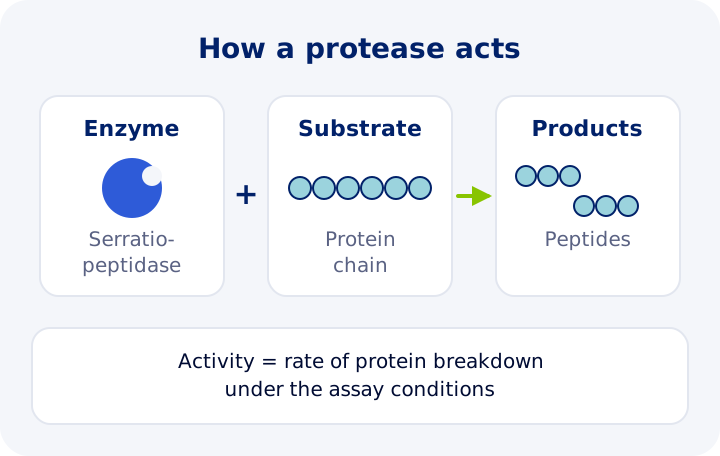
Because it is a protein, serratiopeptidase is sensitive to heat, moisture and strong acid. These properties shape how it is formulated, packed and stored. The glossary entry on serratiopeptidase gives a short definition.
Where is serratiopeptidase used?
Serratiopeptidase is used in oral pharmaceutical formulations, most often tablets, either alone or in fixed-dose combinations with other active ingredients where regulators have approved them. It is used for its anti-inflammatory action in approved medicines where permitted.
Its regulatory position is not the same everywhere. It is an approved medicine in some countries, is sold under different product categories in others, and is not permitted in some markets. In Japan, for example, it was withdrawn from the market in 2011 following a regulatory re-evaluation. Every manufacturer must check the status, permitted combinations and labelling rules in each target market before development starts.
For the wider picture of how enzymes are used in medicines, see our article on pharmaceutical enzymes in modern medication.
How does serratiopeptidase differ from other proteolytic enzymes?
Several proteases are used in pharmaceutical formulations, and they are easy to confuse. They differ in source, in the chemistry of their active site and in how their activity is measured:
- Serratiopeptidase is bacterial in origin and is a zinc-dependent metalloprotease.
- Trypsin and chymotrypsin are obtained from animal pancreas and are serine proteases. They are often supplied together, as in our trypsin-chymotrypsin mix.
- Bromelain comes from pineapple and is a cysteine protease; see our pharmaceutical-grade bromelain.
- Papain comes from papaya latex and is also a cysteine protease; see Papain IP/USP.
Because each enzyme has its own assay, substrate and unit, their activities cannot be compared directly, and one cannot simply replace another in a formula. Each also has its own regulatory position, which must be checked separately.
What does IP grade mean?
A pharmacopoeia is an official book of quality standards for medicines. The Indian Pharmacopoeia (IP) includes a monograph for serratiopeptidase, which defines:
- The identity tests the material must pass.
- The activity assay, including the substrate, conditions and unit.
- Limits for moisture, impurities and other quality attributes.
- Storage requirements.
“Serratiopeptidase IP” therefore means material that meets every requirement of that monograph, tested batch by batch. Serratiopeptidase is not described in every pharmacopoeia, so buyers outside India should confirm which standard their regulator expects. The glossary explains pharmacopoeia grades in more detail. Always work to the current edition of the monograph, as requirements can change between editions.
What should you check on a specification and CoA?
The specification lists the tests and limits; the CoA reports one batch’s results against them. Review both before you approve a source.
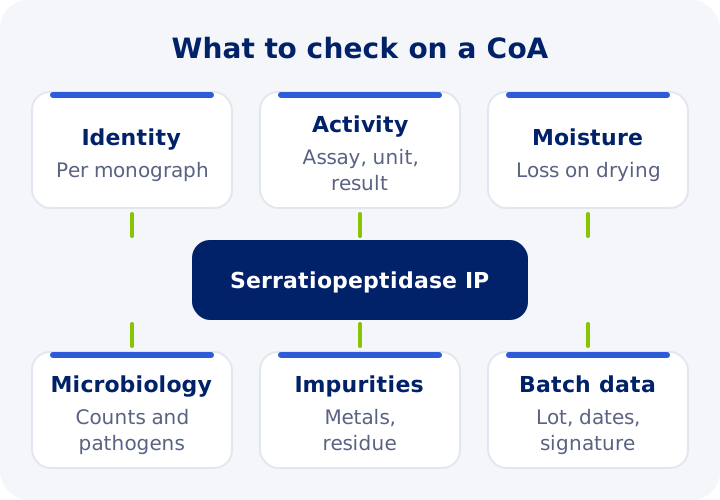
| Parameter | What it tells you | What to confirm |
|---|---|---|
| Description | Appearance of the powder | Matches the specification |
| Identification | The material is serratiopeptidase | Method as per the monograph |
| Activity | Enzyme strength per unit weight | Assay method, unit and result |
| Loss on drying | Moisture content | Within limit; affects stability |
| Microbial quality | Counts and specified organisms | Meets oral-product requirements |
| Batch data | Lot number, dates, approval | Traceable to your delivery |
Why the activity unit matters
The declared activity is the most important figure on the CoA, and the easiest to misread. Activity is defined by the assay method: the substrate, pH, temperature and timing. A result from one method cannot be compared directly with a result from another. Before you compare suppliers, confirm that both report activity by the same monograph method and in the same unit. The glossary entry on the enzyme unit explains why.
Also check what the CoA does not show. Ask whether residual-solvent and elemental-impurity statements are available if your dossier needs them.
Which formats are available?
| Format | What it is | Formulation note |
|---|---|---|
| Bulk powder | Standardised active ingredient | Most flexible; needs acid protection in the dose form |
| Coated granules or pellets | Powder pre-processed for protection | Offered by some suppliers; check the coating spec |
| Finished tablets | Made by the formulator | Usually enteric-coated |
Ask your supplier which forms and activity levels are available, and request the current technical data sheet for each.
How is serratiopeptidase formulated?
Serratiopeptidase loses activity in strong acid, so oral tablets are usually enteric-coated. The coating keeps the tablet intact in the stomach and releases it in the less acidic small intestine. Other points to manage:
- Heat and moisture in processing: wet granulation, drying and compression can all reduce activity. Control temperatures and humidity, and test activity after each critical step.
- Excipient compatibility: screen excipients early, as some can affect enzyme activity.
- Overage: where activity declines over shelf life, a justified overage based on stability data keeps the product within its label claim.
- Assay transfer: agree the assay method with your supplier before stability studies start, so results stay comparable.
Tip: Run a small activity-recovery test on a trial batch before scale-up. Comparing input activity with tablet activity shows how much your process costs you.
How should it be stored and handled?
Keep serratiopeptidase in tightly closed containers, protected from moisture and heat, under the conditions stated on the label and TDS. Reseal opened containers promptly and use them within the period your quality system allows.
Like other enzyme powders, serratiopeptidase can cause respiratory sensitisation if inhaled. Use dust control, local exhaust ventilation and the protective equipment set out in the safety data sheet.
How to source serratiopeptidase
When choosing a supplier, look for:
- Manufacture under GMP in a registered facility, with a current specification to the IP monograph.
- A batch CoA with a clearly stated assay method and unit.
- Stability data at the recommended storage conditions.
- A written commitment to notify changes to strain, process or site.
- Samples from a representative batch for your own testing.
Documents for a registration file
If the serratiopeptidase is going into a medicine that needs a registration or a dossier, ask early which supporting documents the supplier can provide. Typical requests include the specification and method of analysis, CoAs for several consecutive batches, stability data, evidence of GMP certification for the manufacturing site, and a description of the manufacturing process. Because the enzyme is made by fermentation, some regulators also ask whether any animal-derived materials are used in the fermentation media, so request a statement on this point.
Our enzyme supplier qualification checklist covers these steps in more detail. Overseas buyers can read about export documentation on our global supply page.
Working with Enzyme Bioscience
Enzyme Bioscience supplies Serratiopeptidase IP as part of its pharmaceutical enzymes range, manufactured in an FDA-registered, GMP facility in Surat with in-house R&D and QC laboratories. Request a sample, TDS and CoA to support your formulation and qualification work.
Frequently asked questions
Serratiopeptidase, also called serrapeptase or serralysin, is a proteolytic enzyme that breaks down proteins into smaller peptides. It is produced by fermentation of Serratia bacteria and is used as an active ingredient in pharmaceutical formulations in several markets.
Serratiopeptidase is used for its anti-inflammatory action in approved medicines where permitted. Its regulatory status varies by country: in some markets it is an approved medicine, in others it is sold under different rules or is not permitted, so each manufacturer must check the position in its own target markets.
Serratiopeptidase IP is serratiopeptidase made and tested to the monograph in the Indian Pharmacopoeia. The monograph sets the identity test, activity assay and purity requirements that each batch must meet, and the results are reported on the batch certificate of analysis.
Check that the certificate of analysis states the pharmacopoeial grade, the batch number and dates, and results for description, identification, activity, loss on drying and any impurity and microbial tests required by the specification. Also confirm that the activity assay method and unit match those in your own specification.
Serratiopeptidase is a protein and loses activity in strongly acidic conditions such as those in the stomach. An enteric coating protects the enzyme as it passes through the stomach and releases it in the less acidic small intestine.
Serratiopeptidase should be stored in tightly closed containers, protected from moisture and heat, under the conditions stated on the supplier's label and technical data sheet. Enzyme powders can cause respiratory sensitisation, so handle them with dust control and the protective equipment set out in the safety data sheet.