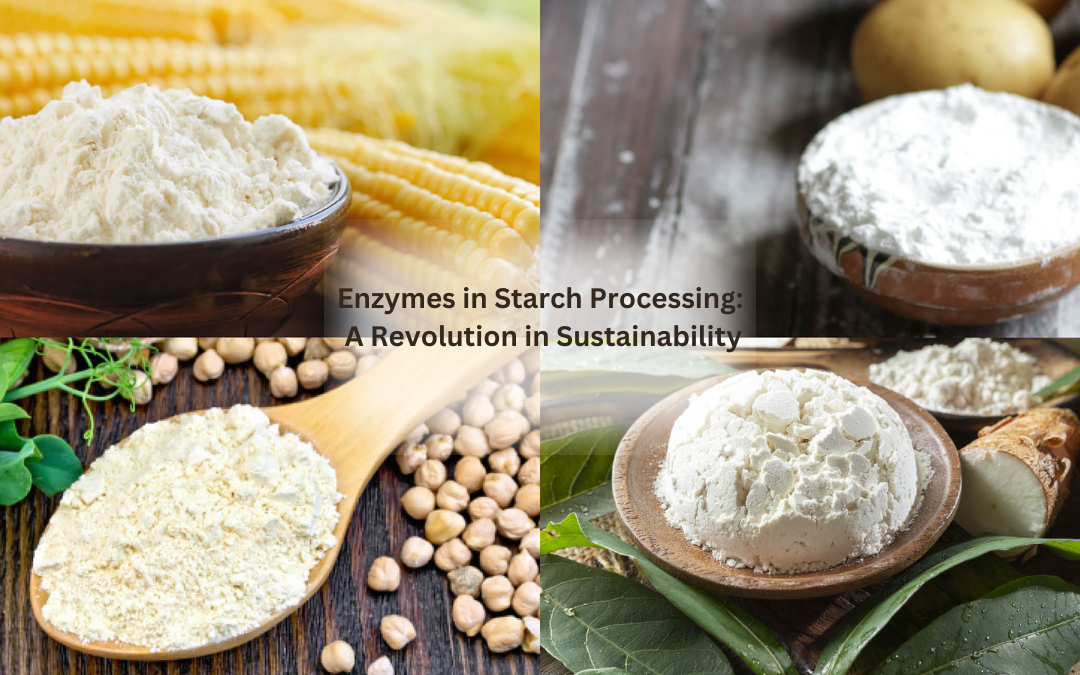
Processing has relied upon mechanical and chemical processes. With enzyme technology having developed, it shifted this whole process onto a newer plane by making the process efficient, eco-friendly, and more versatile. Now starch processing has become an easier process that saves more energy and produces a better quality of products.
This blog will discuss the transformational role of enzymes in starch processing, applications in various industries, and how this technology is forming the future of sustainable production.
What Are Enzymes in Starch Processing?
Enzymes are biological catalysts accelerating chemical reactions. During the starch process, specific enzymes are said to attack the starch molecule and break it down to glucose, maltose, or dextrins. This is helpful in the facilitation of processes, substituting harmful chemicals, and the improvement as a whole in the final product.
Key enzymes used in starch processing include:
Amylases (alpha-amylase and beta-amylase): convert starch to smaller dextrins or maltose.
Glucoamylases: convert dextrins into glucose that makes sweetener.
Pullulanase: facilitate starch debranching. This contributes in better yield of glucose and maltose.
Isoamylases: high-grade maltodextrin productions.
Applications of Enzymes in Starch Processing
1. Production of Sweeteners
The most significant utilization of enzymes in starch processing is the manufacture of sweeteners glucose syrup, maltose syrup, and high-fructose corn syrup (HFCS), commonly used for sweetening in food and beverages Enzyme.
Process:
Alpha-amylase converts starch into short chain dextrins
Glucoamylase further converts those dextrins to glucose
Isomerase converts glucose into fructose to prepare HFCS
Advantages:
The use of enzymes makes yield increase and reduces time as well as increases the consistency of the product.
Eliminates the use of harsh chemicals, thereby lessening environmental impact.
2. Ethanol Production
Enzymes are very important for the production of biofuel. They hydrolyse starch to fermentable sugars, which can be fermented into ethanol. This is the biggest application for renewable energy production industries.
Process:
Liquefy the starch using alpha-amylase
Glucoamylase breaks the liquefied starch into glucose
Yeast ferments glucose into ethanol
Advantages:
Production costs go down with minimal usage of energy.
Sustainability enhances as carbon emissions are low.
3. Modified Starch Production
Modified starches, with increased viscosity or solubility, for example, are manufactured through enzymes. They have found several applications, like thickeners in foods, adhesives, and biodegradable materials.
Process:
Starch molecules are debranched through Pullulanase or isoamylase, and these provide a specific texture or functionality.
Advantages:
Producing high-quality modified starch with no addition of harmful chemicals.
With customizable properties, it has been widely applied to a number of industries.
4. Paper and Textile Industries
Enzymes are used in non-food applications to improve the starch performance in paper and textile production. The strength of paper, its surface coating, and the finishing of fabrics are enhanced by the use of enzyme-treated starch.
Process:
Amylases slightly hydrolyze starch. The products are easier to use in paper or textiles production.
Advantages:
Promotes quality of product.
Reduces water and energy consumption during manufacturing.
5. Brewing and Fermentation
In breweries, starch processing-derived enzymes will be used in the breaking down of cereal starches into fermentable sugars that power the fermentation process thereby producing alcohol.
Process:
Amylase breaks down starch into fermentable sugars that are fermented into alcohol by yeast.
Benefits:
It ensures quality and flavor consistency in alcoholic beverages.
Fermentation becomes faster, and yield increases.
Advantages of Using Enzymes in Starch Processing
Eco-Friendly and Sustainable
Harsh chemicals are usually used in traditional starch processing, thus polluting the environment. Being biodegradable, enzyme-based starches derive from natural sources and do not harm the environment as traditional starches do. This eliminates chemical waste, energy usage is lower, and less water usage makes it sustainable.
Cost-Efficiency
Although enzymes appear expensive, they are more efficient. In fact, an enzymatic process consumes less energy and works under more favorable conditions, increasing yields for a product. The latter brings long-term benefits regarding the cost of producing such products.
Better Quality Product
With enzymes, there is greater control over the hydrolysis of starches. This makes for higher-quality final products, particularly in food and beverage industries where taste and consistency are factors.
Versatility
From biofuels to textiles, and from sweeteners to paper, this whole variety of applications does clearly demonstrate the adaptability as well as versatility of an enzyme.
Conclusion
The application of enzymes in the processing of starch is only just revolutionary. The biological catalysts changed the way various industries would work with the starch and now provide this clean, green, far more efficient alternative to anything that had previously been regarded as conventional. All sectors – from making sweeteners and ethanol to making paper and textiles – showed the value of enzymes to be invaluable.
As technology progresses, enzyme-based processes will be more precise, inexpensive, and sustainable. Not only can industries increase their productivity but also contribute to the health of the planet when they opt for enzymatic solutions.
The future for starch processing will be enzymatic—innovative, green, and of excellence.