Sustainable Food Processing is reshaping the modern food industry as it faces mounting pressure to reduce environmental impact. A food scientist examines an enzymatic processing setup in a lab, representing how enzymes are applied to modern food production for sustainability. Traditional methods are resource-intensive and generate significant waste that strains ecosystems. In fact, global food systems contribute roughly 30% of greenhouse gas emissions and produce billions of tons of waste each . The good news is that enzymes often called nature’s catalysts – offer a positive path forward by enabling greener, more efficient food .
Enzymes: Natural Catalysts for Greener Processes
Enzymes are biological catalysts that speed up chemical reactions. In food processing, they provide a natural alternative to harsh chemical methods. By breaking down complex food molecules with precision, enzymes improve yields and product quality while lowering the environmental . For example, amylase and cellulase can extract more starch and fiber from grains or fruits, meaning more output from the same input and less leftover . Moreover, because many enzymes work under mild conditions – at lower temperatures and neutral pH – they save energy and, being biodegradable, leave no harmful .

Key benefits of using enzymes in food processing include:
- Waste Reduction: Enzymes break down byproducts (e.g. fruit peels or pomace) to extract more usable product, boosting yields by up to 10% and minimizing organic .
- Energy Savings: Enzymatic processes often run at lower heat and neutral pH, cutting energy requirements – achieving up to ~20% energy savings in some .
- Fewer Chemicals: Enzymes can replace certain synthetic additives or harsh processing aids, helping manufacturers eliminate the use of some chemical .
Food Waste with Enzymes
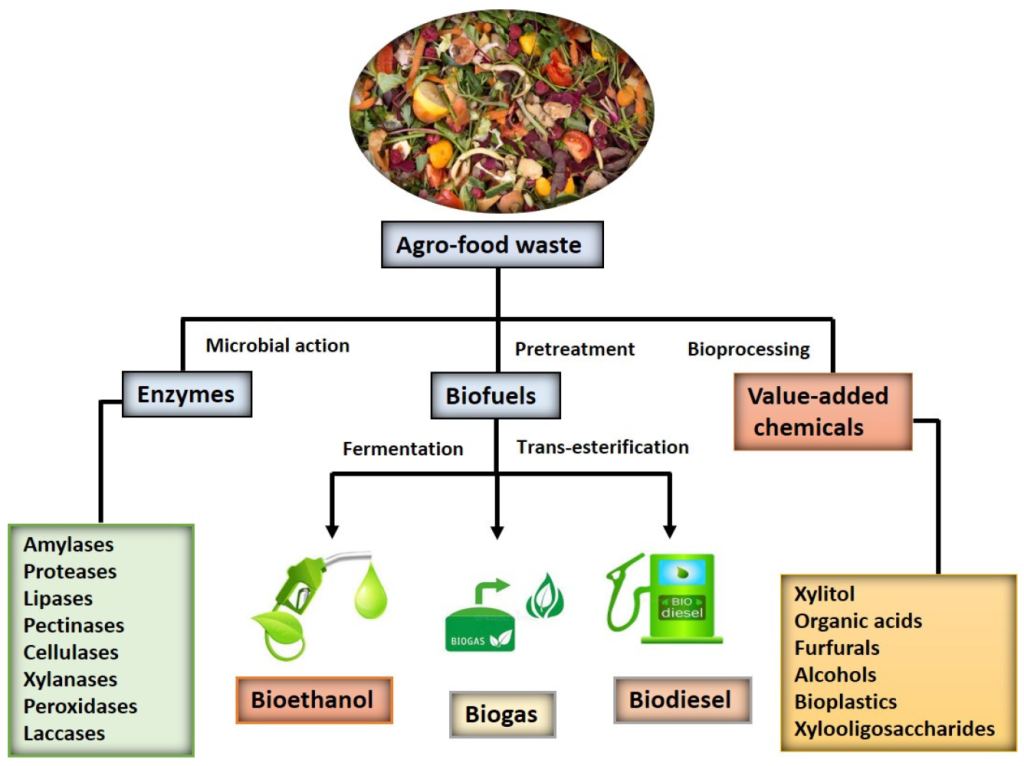
Enzymes are increasingly seen as “heroes” of sustainability, able to turn would-be waste streams into value-added . In processing lines, this means side streams like whey or fruit pulp can be converted into useful inputs instead of being discarded. Pectinase enzymes, for instance, allow more juice to be pressed from fruit ; likewise, dairy enzymes enable byproducts such as whey to be repurposed into nutritional ingredients rather than going to .
Additionally, enzymes help at the consumer end by extending food shelf life – for example, keeping bread soft and edible for longer which directly cuts down on spoiled . In composting or anaerobic digestion, added enzymes can also speed up the breakdown of food scraps, turning waste into useful outputs like biogas much .
Innovating for a Sustainable Future
Companies like Enzyme Bioscience are at the forefront of enzyme innovation, developing plant-origin solutions that replace traditional chemical processes. These eco-friendly enzyme formulations help manufacturers achieve greener operations, reportedly cutting environmental impact by up to 30% in certain . By equipping industry with such tools, they enable food to be processed in cleaner, safer, and more sustainable ways.
Conclusion
Enzymes have emerged as unique catalysts driving positive change in food production. From reducing resource use in factories to minimizing waste, their contributions are transforming sustainable practices in the food and biotech sectors. Ongoing advancements in enzyme technology will continue to unlock new opportunities for greener food processing and waste reduction. Embracing these biological catalysts is not only good for efficiency, but also crucial for the health of our planet.
References & Further Reading
- Energy & Waste Reduction Enzymes enable low-energy processes and reduce waste—examples include up to 20% energy savings in brewing and up to 10% yield increases in juice production WinssolutionsNew Food Magazine.
- Circular Economy & Waste Valorization Enzymes help convert food and by-product waste into valuable ingredients or biofertilizers, supporting sustainability and revenue generation New Food MagazineNutrition Industry Executive MagazineKerry Health And Nutrition Institute.
- Shelf Life & Quality Improvement By enhancing shelf life (e.g., extending bread freshness by 2 days reduces waste by ~40%), enzymes improve product quality and reduce food spoilage New Food MagazineNutrition Industry Executive MagazineBiocatalysts.
- Alternative Ingredients & Local Sourcing Enzymes enable use of alternative grains in brewing (e.g., sorghum, cassava) and reduce reliance on imported inputs, boosting sustainability and local economies New Food MagazineNutrition Industry Executive Magazine.
- Education & Awareness The Agnes Pockels Student Laboratory initiative—featured by Mischnick et al.—demonstrates the importance of educating the next generation about food science, waste, and sustainability using chemistry experiments ChemistryViews.
- Enzyme Bioscience Pvt. Ltd., Company Mission Statement – Highlights the company’s commitment to eco-friendly enzyme innovations (plant-derived enzymes that reduce environmental impact)enzymebio.com.